Ask most people what determines when they can retire and you'll hear a familiar list of answers. A bigger salary. Better investments. Picking the right stocks. Timing the market. Perhaps even a lucky inheritance.
Yet when you strip away the noise, there is one number that matters more than almost anything else.
Your savings rate.
The percentage of your income that you save and invest has an extraordinary impact on how quickly you can achieve financial independence. In fact, it often matters far more than your investment returns, your salary level, or whether you invest in active funds or index funds.
The maths behind this concept is surprisingly simple, but the implications can be life changing. Once you understand how your savings rate affects your retirement date, you may never look at your finances the same way again.
Why Savings Rate Matters More Than Income.
Many people assume high earners automatically become wealthy. While earning more certainly helps, income alone does not create financial freedom.
Consider two individuals:
- Person A earns £30,000 per year and saves 30%.
- Person B earns £100,000 per year and saves 5%.
Person A saves £9,000 annually while Person B saves only £5,000.
Despite earning more than three times as much, Person B is moving towards financial independence at a slower pace.
The real determinant of wealth building is not what you earn. It is what you keep.
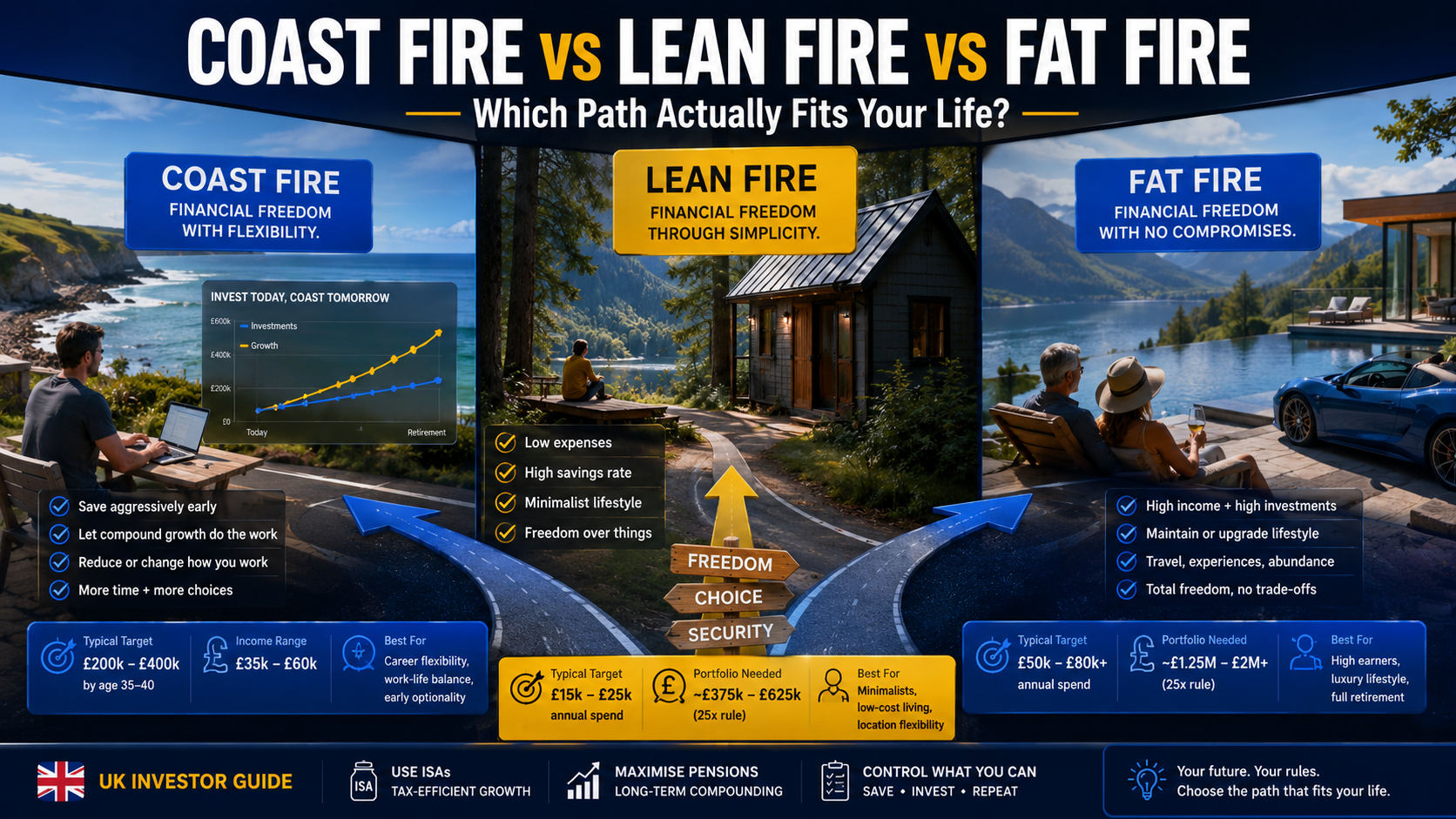
This principle sits at the heart of the Financial Independence Retire Early, or FIRE, movement that has gained popularity around the world.
The Simple Formula That Determines Retirement.
Financial independence occurs when your investments can generate enough income to cover your annual spending.
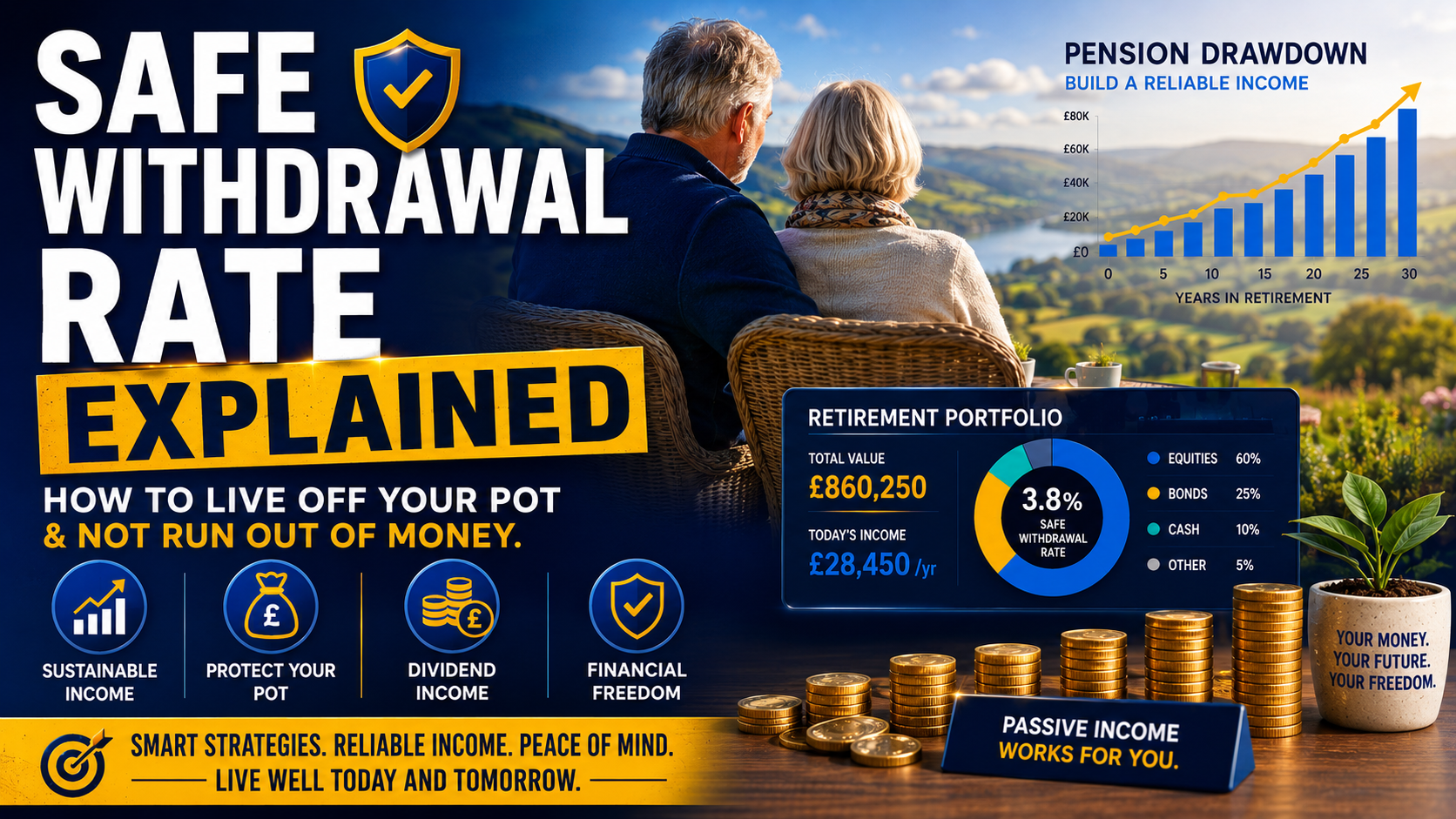
Many FIRE advocates use the 4% rule as a rough guideline.
The concept is straightforward:
Annual Spending × 25 = Financial Independence Number
If you spend £30,000 per year, you would need approximately:
£30,000 × 25 = £750,000
Once your investment portfolio reaches £750,000, you may theoretically be able to withdraw around 4% annually without running out of money over a long retirement period.
The crucial point is that your savings rate directly affects both sides of this equation.
Higher savings increase the amount invested each year.
At the same time, spending less reduces the size of the portfolio you need.
This creates a powerful double benefit.
The Maths That Changes Everything.
Let's look at some examples using a simplified model.
Assumptions:
- Investment returns of 7% annually.
- Consistent income over time.
- Savings invested regularly.
Saving 10% of Income.
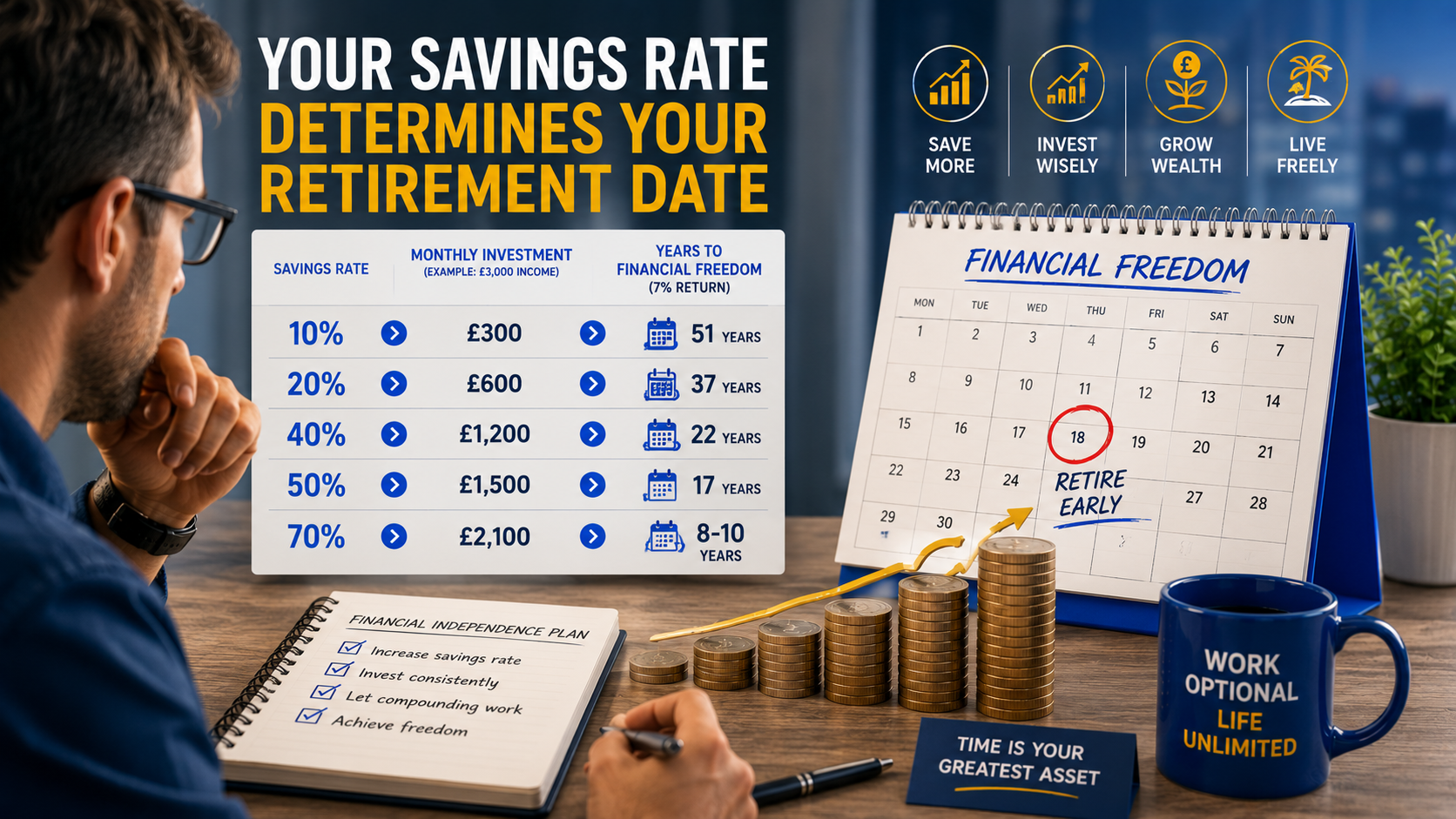
Someone saving 10% of their income may need approximately 51 years of work before reaching financial independence.
For many people, this means working from their early twenties until their seventies.
Saving 20% of Income.
Doubling the savings rate to 20% reduces the timeline dramatically.
Financial independence may be reached in approximately 37 years.
Saving 40% of Income.
At a 40% savings rate, the timeframe falls to around 22 years.
Saving 50% of Income.
At a 50% savings rate, financial independence can often be achieved in around 17 years.
Saving 70% of Income.
A highly disciplined saver investing 70% of their income could potentially reach financial independence in as little as 8 to 10 years.
The difference is remarkable.
A change in savings behaviour can have a greater impact on retirement timing than years spent chasing higher investment returns.
What UK Savers Are Actually Doing.
While the maths is powerful, reality tells a different story.
According to the Office for National Statistics, the UK household saving ratio stood at around 11.1% in early 2024 after recovering from a post-pandemic low of 6.6%.
That means the average household is saving only around one-tenth of its disposable income.
Based on the financial independence calculations above, a savings rate around this level could mean working for several decades before retirement becomes possible.
The challenge is significant because millions of Britons are not currently saving enough for later life.
A government-backed Pensions Commission report recently warned that at least 15 million Britons may not be saving adequately for retirement.
Why Most People Focus on the Wrong Things.
Investment headlines often concentrate on market predictions.
People spend hours debating:
- Which shares will outperform.
- Whether property is better than stocks.
- The next market crash.
- The latest economic forecast.
Yet many of these factors are outside our control.
Your savings rate, however, is something you can influence immediately.
Increasing your savings rate from 10% to 20% could potentially have a greater impact on your financial future than trying to improve investment returns by one or two percentage points.
This is why many successful investors focus on behaviour before performance.
The Hidden Advantage of Higher Savings Rates.
There is another benefit that often goes unnoticed.
People who save more generally learn to live on less.
This means their target retirement portfolio becomes smaller.
Imagine two people earning £50,000 annually.
Person A spends £45,000.
Person B spends £30,000.
Using the 25 times rule:
- Person A needs approximately £1.125 million.
- Person B needs approximately £750,000.
Not only is Person B investing more each year, but they also need significantly less money to become financially independent.
This is why savings rate has such a powerful influence over retirement timing.
The Reality of Retirement in the UK.
Retirement remains a major concern for many households.
Government analysis suggests a typical median earner may need around 67% of their pre-retirement income to maintain a similar standard of living during retirement.
Meanwhile, pension wealth varies dramatically by age.
Recent UK figures show median private pension savings of approximately:
- £18,800 for ages 25 to 34.
- £39,500 for ages 35 to 44.
- £80,000 for ages 45 to 54.
- £137,800 for ages 55 to 64.
These figures highlight an important reality.
Many people arrive in their fifties wishing they had started saving earlier.
The good news is that increasing your savings rate today can still make a substantial difference.
How to Increase Your Savings Rate Without Feeling Miserable.
The idea of saving more can sound restrictive, but it does not have to mean sacrificing everything you enjoy.
Some practical approaches include:
Automating investments so money is invested before it can be spent.
Increasing pension contributions whenever you receive a pay rise.
Using Stocks and Shares ISAs for tax-efficient investing.
Reducing recurring expenses that provide little long-term value.
Avoiding lifestyle inflation as income grows.
Even small increases can create significant results over time.
A move from a 10% savings rate to 15% may not feel dramatic today, but over decades it can transform your financial future.
Financial Freedom Is More Achievable Than Most People Think.
The most motivating aspect of all this is that financial independence is not reserved for millionaires.
Many people assume they need an enormous income to retire comfortably.
The reality is that consistent saving, disciplined spending, and long-term investing often matter far more.
You do not need to predict markets.
You do not need to find the next winning stock.
You do not need a six-figure salary.
You simply need a savings rate that steadily moves you towards your goals.
The sooner you start, the more powerful compounding becomes.
Every pound saved today is a worker you send out to earn more money on your behalf tomorrow.
Your Retirement Date May Already Be Hidden in Your Budget.
If there is one lesson to take away, it is this.
Your savings rate is not just a percentage on a spreadsheet. It is a rough estimate of how much freedom you are buying with every pay cheque.
The higher your savings rate, the sooner work becomes optional rather than mandatory.
Financial independence is not built through one perfect investment decision. It is built through hundreds of consistent choices repeated over many years.
And the most important number behind those choices is the percentage of your income that you keep.
Want to start building wealth with confidence? Subscribe today and get your free copy of the Investing for Beginners Handbook delivered straight to your inbox.