For decades, investors have debated one of the most important questions in personal finance: should you invest in low-cost index funds or trust professional fund managers to beat the market?
It is a discussion that has shaped billions of pounds of investment decisions across the UK and around the world. Supporters of active management argue that skilled fund managers can identify opportunities, avoid market pitfalls and generate superior returns. Advocates of passive investing believe that consistently beating the market is far harder than most investors realise and that low costs are often the deciding factor.
When examined over a 20-year investment horizon, however, the evidence becomes increasingly difficult to ignore. Long-term performance data, fee comparisons and industry research all point towards a clear winner in most circumstances.
Understanding The Difference.
An index fund is designed to track the performance of a market index such as the FTSE 100, FTSE All-Share or S&P 500. Rather than attempting to outperform the market, it aims to replicate it as closely as possible.
An actively managed fund takes a different approach. A professional fund manager researches companies, selects investments and makes buying and selling decisions in an effort to outperform a benchmark index.
The appeal of active management is obvious. Investors hope a talented manager can identify winning investments before the wider market does. The challenge is that every active manager is competing against thousands of other professionals with access to similar information and resources.
Over short periods, some managers outperform. Over longer periods, maintaining that advantage becomes increasingly difficult.
What The Long-Term Data Shows.
One of the most widely respected studies in the investment industry is the SPIVA Scorecard, produced by S&P Dow Jones Indices. The research has tracked active fund performance against benchmark indices for more than two decades across global markets.
The findings are remarkably consistent.
In many equity sectors, the majority of actively managed funds fail to outperform their benchmark over long periods. Research covering UK and European funds has repeatedly shown that underperformance rates rise as the investment period lengthens. Over ten years, more than 80% of active funds in many categories have lagged their benchmark indices.
For UK equity funds specifically, only around 18% of active funds managed to outperform their benchmark over a ten-year period, meaning roughly 82% underperformed.
While twenty-year UK-specific figures vary across fund sectors, the broader global evidence remains striking. Morningstar research shows that active fund success rates often fall into single digits over twenty-year periods in major equity categories.
The longer the time horizon, the more difficult it becomes for active managers to maintain a performance advantage.
Why Fees Matter More Than Most Investors Realise.
One of the biggest reasons index funds often come out ahead is cost.
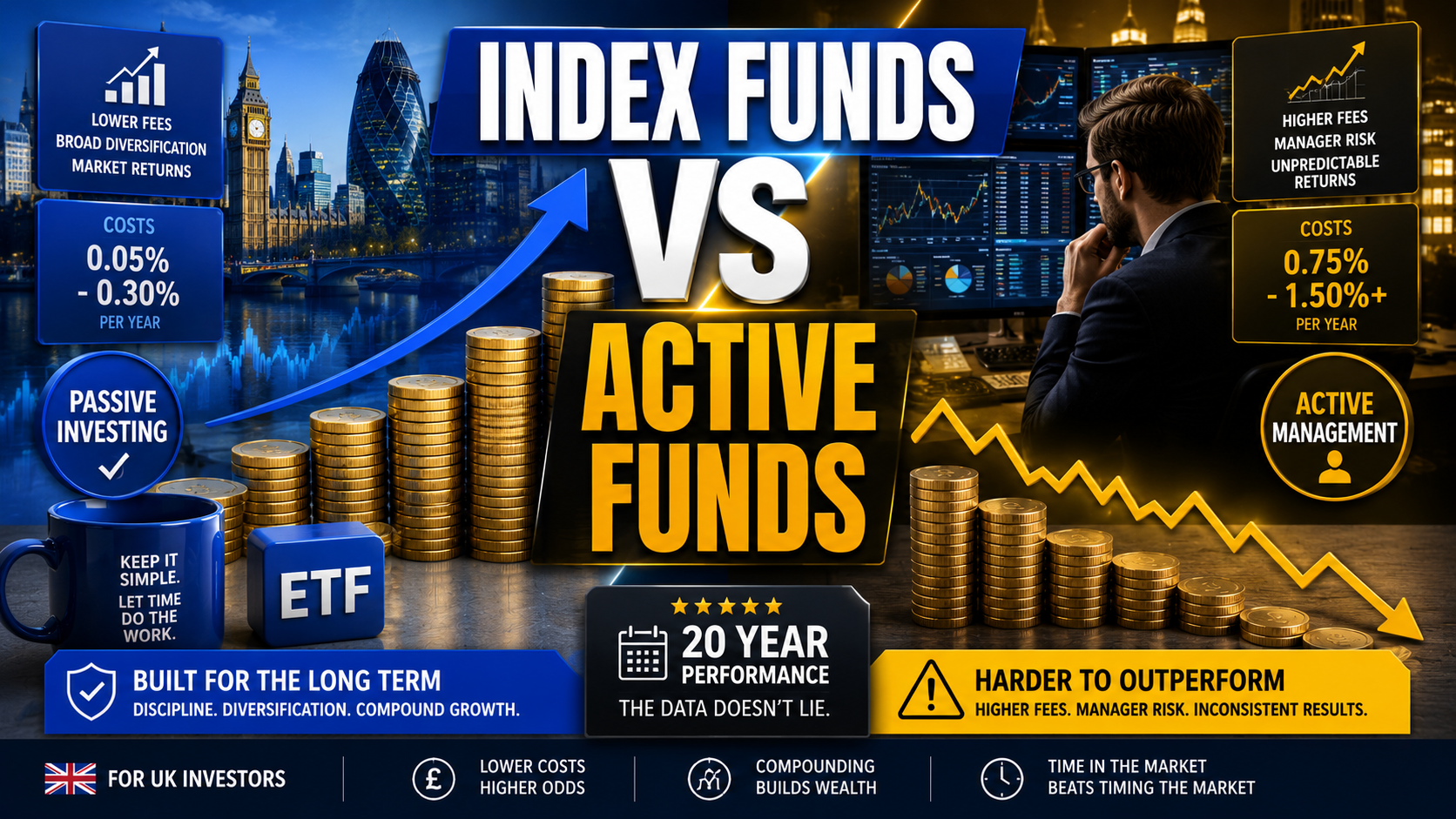
A typical UK index fund or ETF may charge between 0.05% and 0.30% annually. Many actively managed funds charge closer to 0.75% to 1.50%, with some specialist funds charging even more.
At first glance, the difference may appear insignificant. However, investing is a game of compounding.
Imagine two investors each start with £20,000 and achieve the same gross annual return of 7% before fees over 20 years.
Investor A pays 0.20% in annual fees.
Investor B pays 1.20% in annual fees.
By the end of the period, Investor A could have thousands of pounds more simply because less money was lost to fees every year.
The impact becomes even more significant for larger portfolios and longer investment horizons.
This is one reason legendary investor Warren Buffett has frequently advocated low-cost index investing for most people.
The Hidden Challenge Facing Active Managers.
Many investors assume active managers have an advantage because they employ teams of analysts and conduct extensive research.
The reality is more complicated.
Modern financial markets are highly efficient. Information spreads almost instantly. Thousands of institutional investors, hedge funds, banks and fund managers analyse the same companies simultaneously.
When one manager discovers an opportunity, countless others are often seeing the same thing.
Professor William Sharpe famously described this challenge through what became known as the "Arithmetic of Active Management". Before costs, the average active investor must equal the market return because active investors collectively make up the market. After costs, the average active investor must underperform.
That simple concept explains much of the long-term data.
Where Active Funds Can Still Add Value.
Despite the evidence supporting passive investing, active management is not entirely without merit.
Certain market segments appear more favourable to active managers.
Smaller companies, emerging markets and specialist sectors can be less efficient than large-cap markets. This potentially creates opportunities for skilled managers to identify undervalued investments.
Active funds may also provide downside protection during severe market declines by holding cash, reducing exposure to overvalued sectors or focusing on defensive investments.
Some investors prefer active funds because they appreciate the flexibility and human decision-making involved.
However, identifying future outperformers remains extremely difficult. Research consistently shows that yesterday's winning managers often struggle to repeat their success.
The UK Investor Perspective.
For UK investors, the growth of passive investing has been dramatic.
Major providers such as Vanguard, iShares, HSBC and Fidelity now offer low-cost index funds covering UK, US and global markets. These products have become increasingly popular within Stocks and Shares ISAs and Self-Invested Personal Pensions (SIPPs).
The appeal is straightforward.
Investors gain broad diversification across hundreds or even thousands of companies while keeping costs low and avoiding the need to constantly monitor fund manager changes.
Meanwhile, several studies have highlighted the challenges facing active UK funds. Analysis from AJ Bell found that many UK-focused pension funds underperformed comparable index trackers over a decade, with some lagging significantly.
For investors focused on retirement planning, those differences can have a substantial impact on final portfolio values.
What About Market Crashes?
One common argument against index funds is that they simply follow the market down during crashes.
This criticism is partially true.
Index funds do not attempt to avoid downturns. If the market falls, the fund falls.
However, many active funds also struggle during market declines. While some managers successfully reduce losses, many fail to do so consistently.
History shows that investors who remain invested through market downturns often benefit from eventual recoveries. Attempting to predict market movements accurately year after year is extremely challenging.
For most long-term investors, maintaining a disciplined investment strategy has historically proven more effective than trying to time market cycles.
Which Approach Wins Over 20 Years?
When all the evidence is considered together, index funds emerge as the stronger choice for most investors over a twenty-year period.
The reasons are straightforward.
They typically offer lower fees, broad diversification, transparency and consistent market returns. Active managers must not only beat the market but also overcome their higher costs before delivering additional value to investors.
While exceptional active managers certainly exist, identifying them in advance is extremely difficult. The data suggests that most investors who attempt to do so are unlikely to succeed consistently.
That does not mean active investing should be abandoned entirely. Some investors choose a blended approach, using index funds as the foundation of a portfolio while allocating a smaller percentage to carefully selected active funds.
For the majority of long-term investors, however, the evidence increasingly supports a simple conclusion.
The market is already difficult to beat. Paying higher fees for the privilege of trying often makes the challenge even harder.
Over twenty years, patience, diversification and low costs have repeatedly proven to be some of the most powerful tools available to investors.
Subscribe today and get your free copy of the Index Funs for Beginners Guide packed with practical tips to help you start building wealth with confidence.
Keep reading: Stocks and Shares ISA Explained in Plain English (2026/27): A Beginner's Guide to Tax-Free Investing.