The Financial Independence, Retire Early movement has evolved far beyond the simple idea of quitting work in your 40s. Today, there are multiple versions of FIRE, each designed for different income levels, lifestyles and retirement ambitions.
For some people, the goal is complete financial freedom with a luxury lifestyle. For others, it is simply reducing financial stress and gaining more flexibility over their working lives. This has led to the rise of Coast FIRE, Lean FIRE and Fat FIRE, three of the most popular approaches among UK investors.
But which path actually fits your life?
The answer depends less on what social media influencers claim and more on your income, spending habits, family plans and personal definition of freedom.
Why FIRE Has Become So Popular In The UK.
The FIRE movement continues to attract interest as many workers reassess traditional retirement expectations. Rising living costs, changing work patterns and concerns about future pension adequacy have encouraged more people to seek greater financial independence.
The concept is straightforward. Build investments large enough to eventually cover your living expenses. Many FIRE followers use the well-known "25x rule", aiming to accumulate roughly 25 times their annual spending before drawing income from their portfolio.
However, not everyone wants the same retirement outcome. This is where the various FIRE strategies come into play.
What Is Coast FIRE.
Coast FIRE is often considered the most achievable FIRE strategy for average earners.
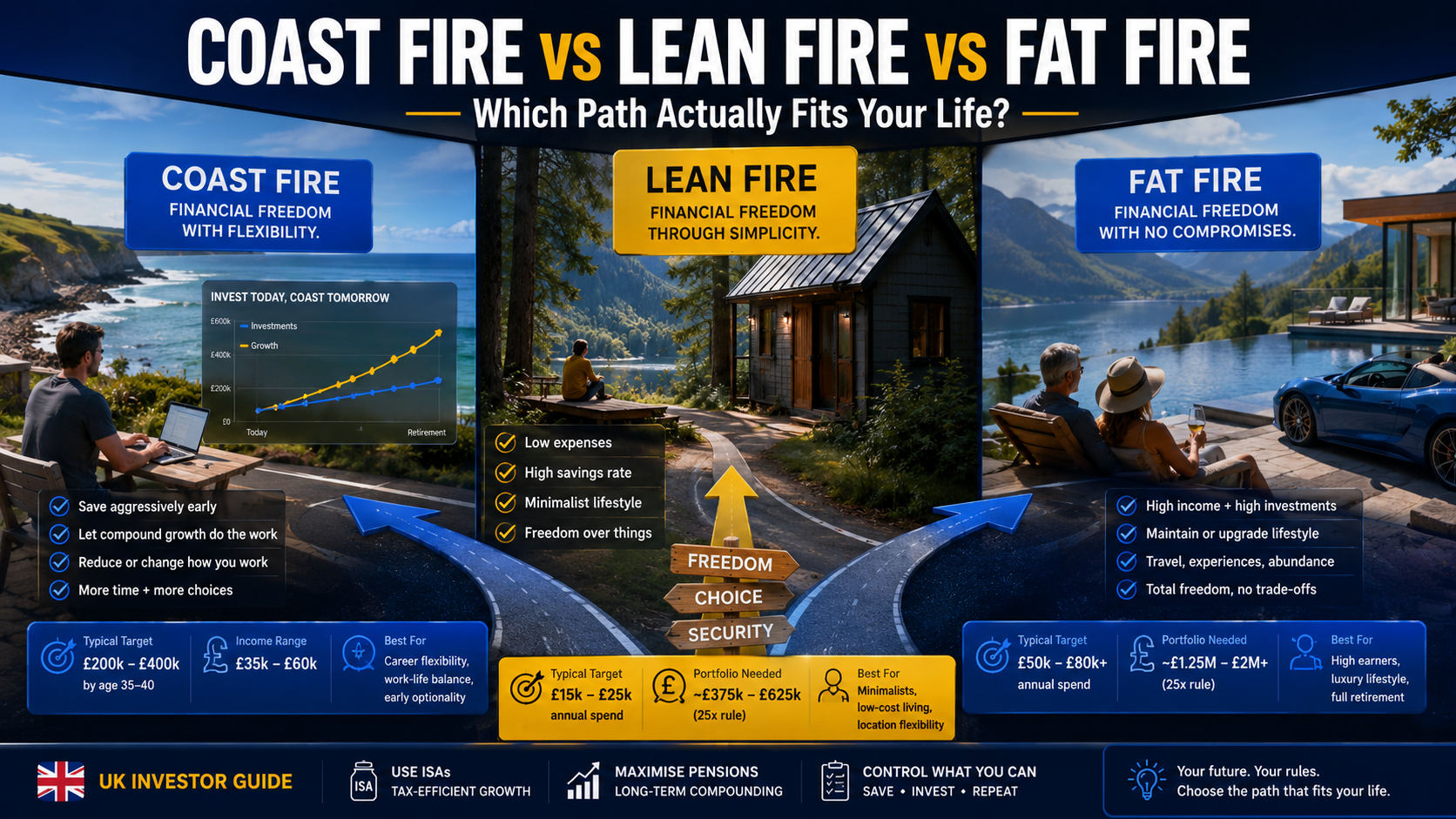
Rather than saving aggressively forever, Coast FIRE focuses on investing heavily during your early years. Once your portfolio reaches a certain size, compound growth can theoretically carry it to your retirement target without significant future contributions.
At that point, you can "coast" by reducing your savings rate, switching careers, working fewer hours or pursuing a less stressful lifestyle.
A recent Business Insider profile highlighted a couple who reached Coast FIRE by building an investment portfolio of approximately $550,000 before focusing more on quality of life and personal priorities.
For UK investors, Coast FIRE can be particularly attractive because it works well alongside Stocks and Shares ISAs and workplace pensions. The goal is not necessarily to retire early but to gain greater freedom over how you spend your working years.
Someone earning £35,000 to £60,000 per year may find Coast FIRE far more realistic than attempting full retirement at 40.
Typical Coast FIRE Profile.
A Coast FIRE follower often:
- Earns a middle-income salary.
- Wants career flexibility.
- Values work-life balance.
- Prefers lower financial pressure later in life.
- Continues working in some capacity.
A typical UK Coast FIRE target might involve building investments worth £200,000 to £400,000 by age 35 or 40, then allowing compound growth to do much of the heavy lifting toward retirement.
What Is Lean FIRE.
Lean FIRE represents the minimalist side of financial independence.
The focus is on dramatically reducing expenses and living comfortably on a relatively modest income during retirement. Many Lean FIRE followers save more than 50% of their income while carefully controlling housing, transportation and lifestyle costs.
In practical terms, Lean FIRE often means targeting annual retirement spending of £15,000 to £25,000 per person.
The appeal is obvious. You need a much smaller investment portfolio to reach financial independence.
For example, someone planning to spend £20,000 annually might target approximately £500,000 invested using the traditional 25x rule.
However, Lean FIRE requires a degree of lifestyle discipline that many people find difficult to sustain over decades.
Typical Lean FIRE Profile.
A Lean FIRE follower often:
- Lives below their means.
- Prioritises freedom over luxury.
- Is comfortable with a modest lifestyle.
- Avoids lifestyle inflation.
- May relocate to lower-cost areas.
This strategy can work particularly well for singles, couples without children or those who enjoy simple living.
The challenge is that unexpected expenses, inflation and changing family circumstances can put pressure on a tightly managed retirement budget.
What Is Fat FIRE.
Fat FIRE sits at the opposite end of the spectrum.
Instead of minimising expenses, Fat FIRE aims to maintain or even improve your current lifestyle after retirement.
This typically requires a much larger investment portfolio, but it offers greater financial flexibility and comfort.
A Fat FIRE investor may want to continue travelling extensively, dining out regularly, supporting family members or maintaining a high-value property portfolio.
In the UK, annual spending targets for Fat FIRE frequently exceed £50,000 to £80,000 per year, with some aiming much higher.
Using the same 25x rule, someone spending £60,000 annually would require approximately £1.5 million invested before considering themselves financially independent.
Typical Fat FIRE Profile.
A Fat FIRE follower often:
- Has a high income.
- Owns multiple investments.
- Prioritises lifestyle flexibility.
- Wants financial security against inflation.
- May retire completely rather than work part-time.
Fat FIRE tends to be most realistic for high earners, business owners, senior professionals and individuals who benefit from substantial investment growth over many years.
Which FIRE Strategy Fits Different Income Levels.
While anyone can apply FIRE principles, income naturally influences which version is most practical.
For UK households earning around the median disposable income level of approximately £32,000 to £39,000 annually, Coast FIRE may offer the most achievable balance between saving and enjoying life today.
Those earning £40,000 to £80,000 often find themselves choosing between Coast FIRE and Lean FIRE depending on their spending habits.
Higher earners above £100,000 are generally better positioned to pursue Fat FIRE, although lifestyle inflation frequently becomes the biggest obstacle.
Interestingly, research consistently shows that financial independence is often driven more by savings rates than income alone. A household saving 40% of earnings can frequently progress faster than a higher-income household saving only 10%.
The UK Challenges Every FIRE Investor Should Understand.
The UK presents several unique considerations that many international FIRE guides overlook.
One major issue is pension accessibility. Pension access is currently scheduled to rise to age 57 from April 2028, creating a potential gap between early retirement and pension availability.
This means many UK FIRE followers rely heavily on ISAs and taxable investment accounts to bridge the years before pension access becomes available.
Housing costs also play a significant role. For many households, reducing housing expenses remains one of the fastest ways to accelerate financial independence.
Meanwhile, real household disposable income growth has been relatively modest over the past decade, making disciplined saving even more important.
Why Many People Are Choosing Coast FIRE Instead.
Although Lean FIRE and Fat FIRE often dominate headlines, Coast FIRE has quietly become one of the most appealing approaches for modern workers.
Rather than chasing an extreme retirement date, Coast FIRE prioritises flexibility.
Many people discover that what they truly want is not permanent retirement. They want options.
They want the ability to leave a stressful job, spend more time with family, start a business, reduce working hours or pursue meaningful projects without financial anxiety.
That makes Coast FIRE particularly relevant for younger professionals who value lifestyle design as much as retirement planning.
Choosing The Right FIRE Path For Your Future.
The biggest mistake people make is assuming there is only one version of financial independence.
Lean FIRE works for those who prioritise freedom over spending.
Fat FIRE suits those seeking complete independence without sacrificing lifestyle.
Coast FIRE offers a middle ground that balances long-term wealth building with present-day flexibility.
Ultimately, the best FIRE strategy is not the one that looks most impressive online. It is the one you can realistically maintain for the next 10, 20 or 30 years.
Financial independence should support your ideal life, not force you into a lifestyle you do not enjoy. Before choosing a FIRE path, ask yourself a simple question: Are you trying to retire early, or are you trying to live better?
Your answer will often reveal which version of FIRE truly fits your future.
Want to start your investing journey? Subscribe today and claim your free copy of the Investing for Beginners Handbook delivered straight to your inbox.