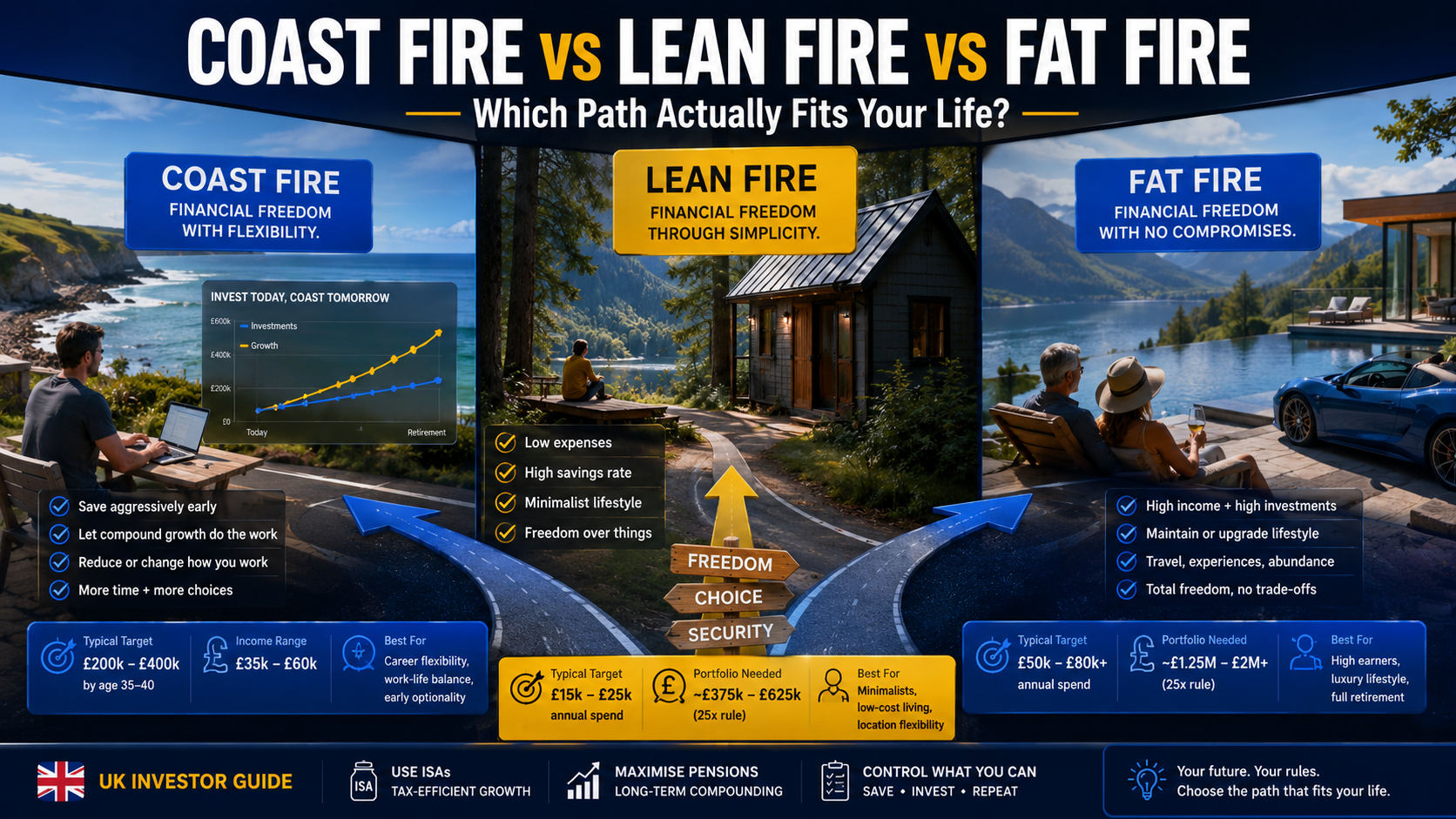
For many people pursuing Financial Independence, Retire Early (FIRE) in the UK, one question keeps coming up: should you prioritise an ISA or a pension?
The answer is rarely one or the other. Instead, the most successful early retirement strategies often combine both. This has become even more important because the minimum age at which most people can access private pensions is set to rise from 55 to 57 on 6 April 2028. That change creates what many investors call the "access-age gap", a period where you may have stopped working but cannot yet draw from your pension.
Understanding how to bridge that gap could be the difference between retiring comfortably in your early fifties and having to work several years longer than planned.
Why The Pension Access Age Matters.
Most UK personal pensions, workplace pensions and SIPPs currently allow access from age 55. However, the Normal Minimum Pension Age will increase to 57 from April 2028 for most savers. The change was introduced to reflect longer life expectancy and to encourage people to keep retirement savings invested for longer.
If you are planning to retire at 50, 52 or 55, this change could have a significant impact on your retirement timeline.
Someone retiring at 52 may need to fund five years of living expenses before pension access becomes available. Without a plan, that gap can become one of the biggest obstacles to achieving financial independence.
This is why many FIRE investors focus heavily on building ISA wealth alongside their pension contributions.
The Tax Advantages Of A Pension.
From a purely mathematical perspective, pensions are incredibly attractive.
Contributions receive tax relief at your marginal rate. A basic-rate taxpayer effectively receives a 20% boost on contributions, while higher-rate and additional-rate taxpayers can receive even greater relief through their tax return.
For example:
- £8,000 contributed becomes £10,000 for a basic-rate taxpayer.
- A higher-rate taxpayer may only need to contribute £6,000 to achieve a £10,000 pension contribution.
- Additional-rate taxpayers can receive even more substantial tax benefits.
Employer contributions make pensions even more powerful. Under automatic enrolment, employers contribute alongside employee contributions, effectively creating free money towards retirement. Around 90% of employed workers now save into a pension through workplace schemes.
For long-term wealth building, pensions are difficult to beat.
However, they come with one major drawback.
You cannot freely access the money until the minimum pension age.
The Flexibility Advantage Of ISAs.
Stocks and Shares ISAs offer a very different benefit.
There is no upfront tax relief, but all growth, dividends and withdrawals are free from UK income tax and capital gains tax. Most importantly, ISA money can be accessed at any age.
This flexibility makes ISAs one of the most valuable tools available to early retirees.
An ISA can fund:
- Living expenses before pension access.
- Unexpected emergencies.
- Career breaks or sabbaticals.
- Reduced working hours before retirement.
- The retirement bridge between ages 50 and 57.
Unlike pensions, there are no withdrawal restrictions or tax calculations when accessing your ISA.
For many FIRE followers, that flexibility is worth almost as much as the tax advantages of a pension.
The ISA Bridge Strategy.
One of the most effective approaches is known as the ISA bridge strategy.
Rather than viewing ISAs and pensions as competing products, investors use them together.
The pension becomes the engine that powers retirement after age 57.
The ISA becomes the bridge that carries you there.
Imagine someone aiming to retire at age 52.
Their annual spending requirement is £30,000.
If pension access begins at age 57, they need approximately five years of expenses available outside their pension.
That equates to roughly £150,000 before accounting for inflation or investment returns.
In this scenario:
- Pension savings provide long-term retirement income.
- ISA savings provide income from ages 52 to 57.
- State Pension may provide additional support later in retirement.
This creates a layered retirement income strategy that balances tax efficiency with flexibility.
How Much Might You Need Before Age 57?
The exact amount depends on your lifestyle and spending habits.
A common FIRE rule suggests multiplying annual spending by the number of years required before pension access.
For example:
- £20,000 annual spending = £100,000 bridge fund for five years.
- £30,000 annual spending = £150,000 bridge fund for five years.
- £40,000 annual spending = £200,000 bridge fund for five years.
Many investors also add a safety margin to account for inflation, market volatility and unexpected expenses.
The goal is to ensure your pension remains untouched until it becomes available while maintaining your desired lifestyle.
Should You Prioritise An ISA Or Pension?
The answer depends largely on your age, earnings and retirement target.
If you are a higher-rate taxpayer, pension contributions often deliver exceptional value because of the significant tax relief available.
If you plan to retire well before age 57, building substantial ISA assets becomes increasingly important.
Many financial planners favour a blended approach:
- Contribute enough to secure full employer pension matching.
- Maximise valuable pension tax relief opportunities.
- Build ISA wealth alongside pension savings.
- Use the ISA as the bridge to pension access.
This approach often provides the best balance between long-term growth and short-term flexibility.
What The FIRE Community Often Gets Right.
One reason many FIRE investors succeed is that they recognise pensions are only one piece of the puzzle.
Rather than relying entirely on pension wealth, they build multiple income sources.
These can include:
- Stocks and Shares ISAs.
- General investment accounts.
- Property income.
- Cash reserves.
- Pension investments.
This diversification creates flexibility and resilience.
Importantly, the increase in pension access age from 55 to 57 does not make FIRE impossible. It simply means investors need a larger bridge between financial independence and pension access.
Common Mistakes To Avoid.
One of the biggest mistakes is focusing exclusively on pensions while neglecting accessible investments.
A person could accumulate a seven-figure pension pot yet still struggle to retire at 52 if they have insufficient accessible assets.
Another mistake is assuming retirement spending will remain constant.
Many retirees experience varying spending patterns throughout retirement, particularly during the early active years.
Finally, avoid ignoring future legislative changes.
The minimum pension age has already increased previously and will rise again in 2028. Future governments could introduce additional changes, making diversification even more valuable.
Building A Tax-Efficient Early Retirement Plan.
For most UK investors, the question is not whether an ISA or pension is better.
The real question is how to use both together.
Pensions remain one of the most tax-efficient investment vehicles available thanks to tax relief and employer contributions. ISAs provide the flexibility required to access wealth before pension age.
By combining the two, investors can create a retirement strategy that balances growth, tax efficiency and accessibility.
For those aiming to retire before 57, the ISA bridge strategy may be one of the most important components of the entire financial plan.
The earlier you begin building that bridge, the easier it becomes to walk across it when the time comes.
For more beginner-friendly investing guides, subscribe and claim your free copy of the Investing for Beginners Handbook today.