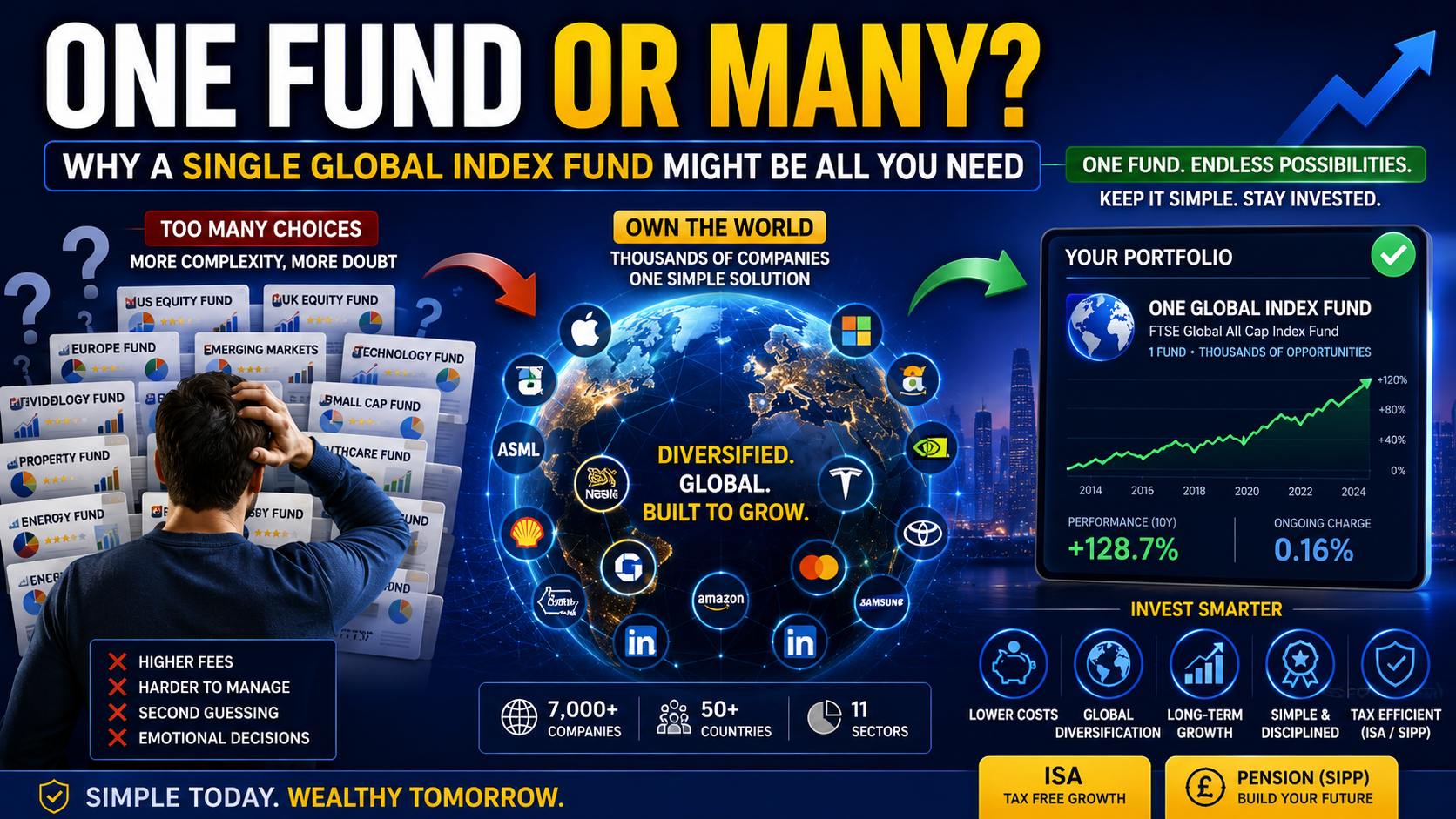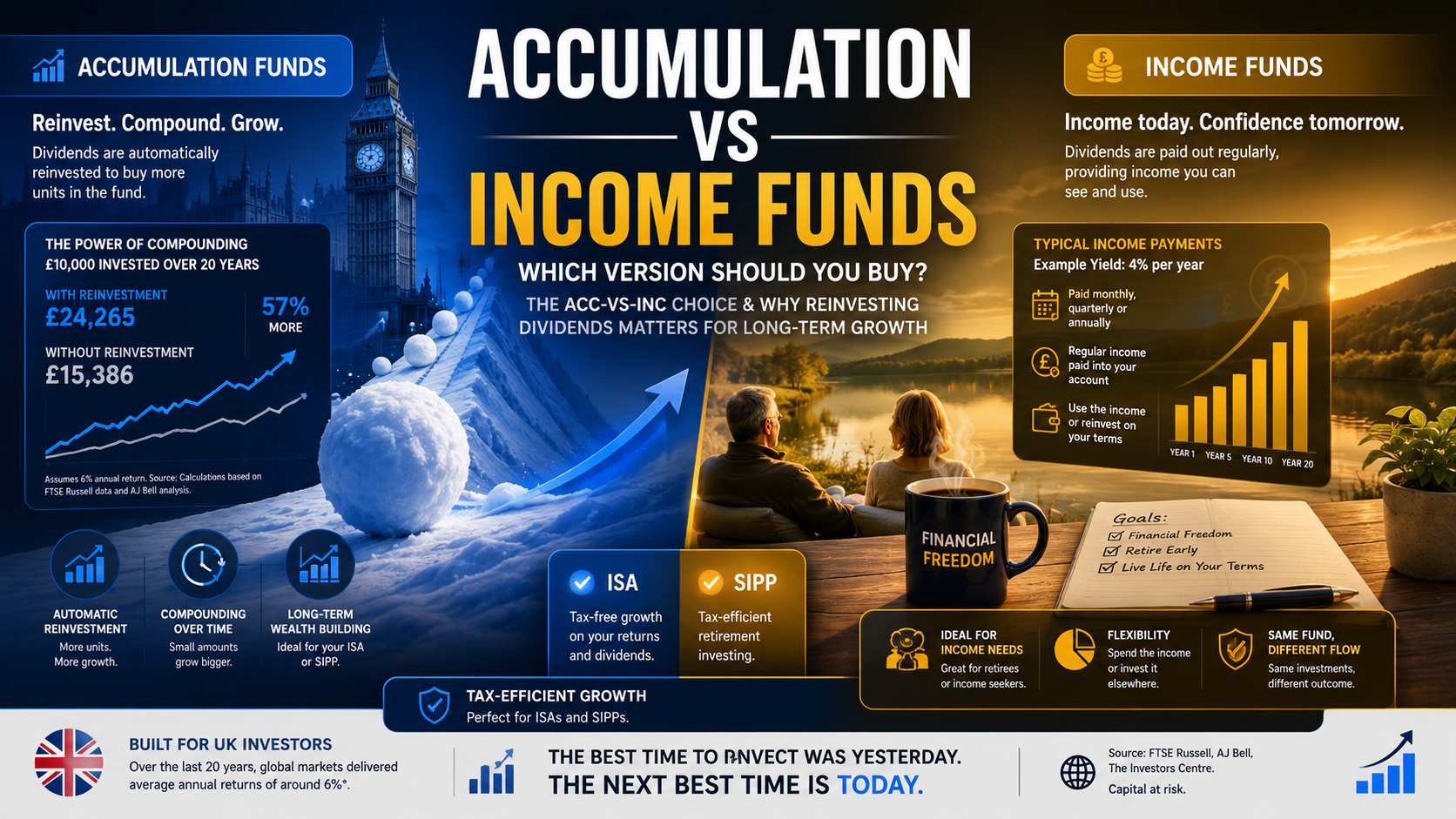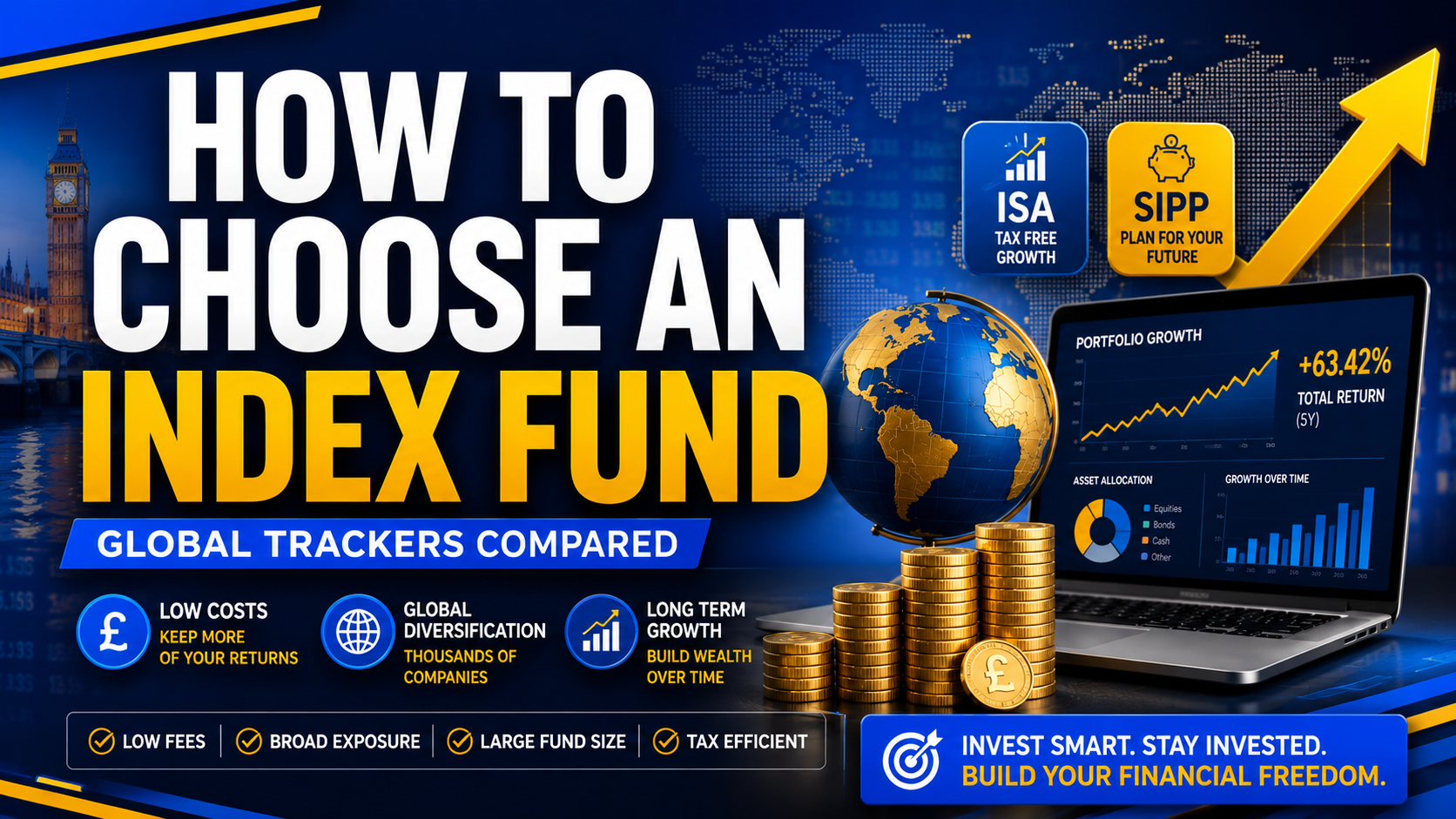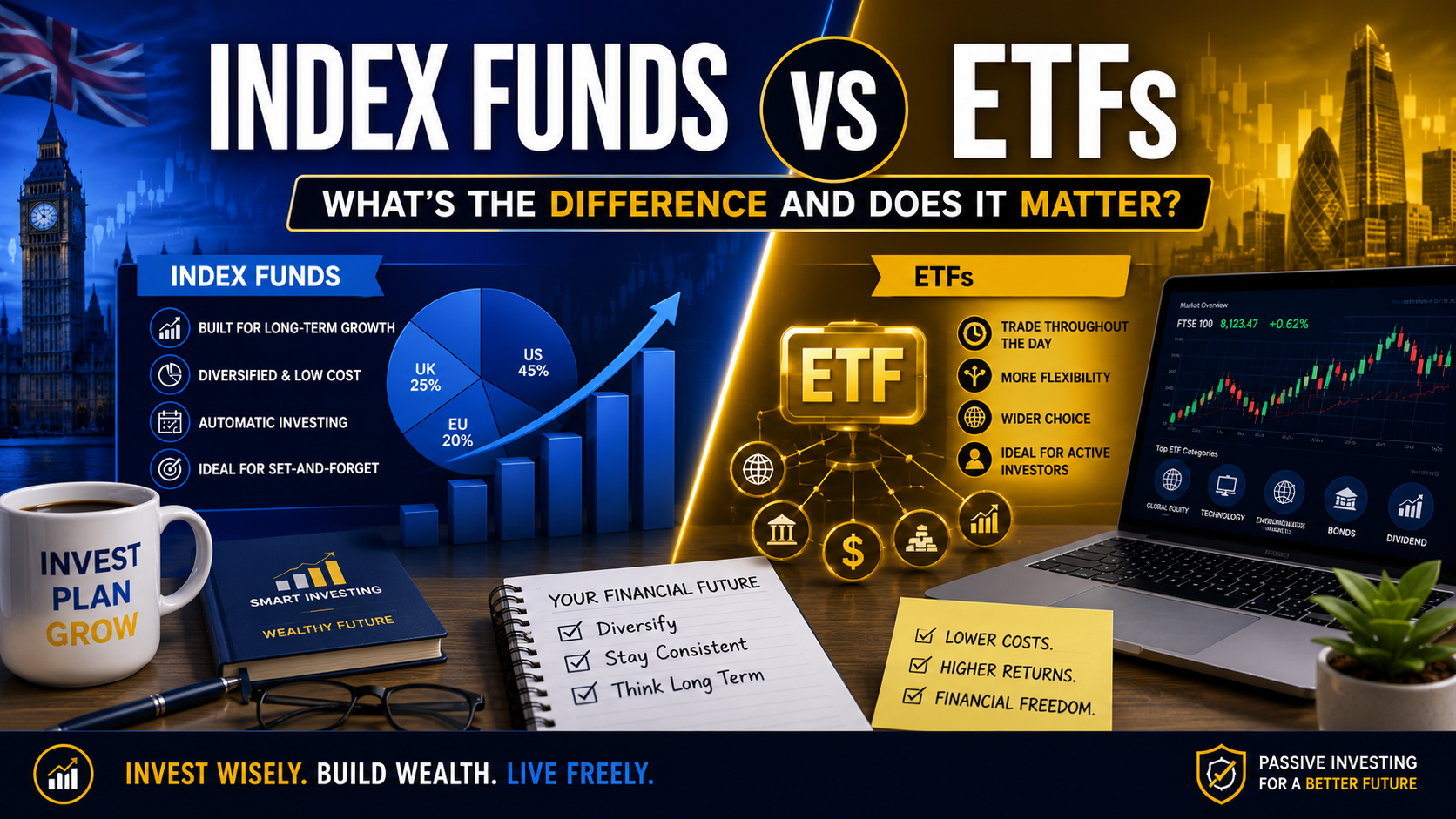
Passive investing has transformed the way millions of people build wealth. Instead of trying to pick winning stocks or beat the market, investors can simply buy a fund that tracks a market index and benefit from long-term market growth.
Yet one question continues to confuse both new and experienced investors: should you choose an index fund or an ETF?
The reality is that both are designed to achieve very similar goals. Both can provide low-cost diversification, broad market exposure and a straightforward way to invest for the future. However, there are important differences that can influence which option is better suited to your circumstances.
Understanding those differences can help you make more informed investment decisions and potentially save money over the long term.
What Are Index Funds?
An index fund is a type of investment fund that aims to replicate the performance of a market index such as the FTSE 100, FTSE All-Share or S&P 500.
Rather than employing a fund manager to select individual shares, an index fund simply holds the companies within the chosen index in the same proportions as the benchmark itself.
For example, a UK investor buying a FTSE 100 index fund automatically gains exposure to many of Britain's largest publicly listed companies including HSBC, Shell and AstraZeneca.
Index funds are often referred to as tracker funds because they are designed to track rather than outperform the market.
Their popularity has grown significantly in recent years as investors increasingly recognise the challenges active managers face in consistently beating market returns after fees. According to Investment Association data, index-tracking strategies have continued to gain market share within the UK investment industry, reflecting growing demand for low-cost investing.
What Are ETFs?
Exchange Traded Funds, commonly known as ETFs, are also investment funds that often track an index. In fact, many ETFs and index funds can hold virtually identical investments.
The key difference is how they are bought and sold.
An ETF trades on a stock exchange throughout the trading day, just like an individual company share. Investors can buy and sell ETF units whenever markets are open, with prices updating continuously.
This flexibility has made ETFs increasingly popular among investors seeking convenience, transparency and low costs.
The UK ETF market has expanded rapidly. The London Stock Exchange now hosts more than 2,350 ETF products with assets exceeding £1 trillion, highlighting the growing demand for exchange-traded investment vehicles.
The Main Differences Between Index Funds and ETFs.
Although both investment vehicles often pursue the same objective, several practical differences exist.
How They Are Traded.
Index funds are generally priced once per day after markets close. When you place an order, you receive the next available valuation price.
ETFs trade continuously during market hours. Investors can buy or sell immediately at prevailing market prices.
For long-term investors contributing monthly, this distinction may have little impact. However, investors who value flexibility often prefer ETFs.
Minimum Investment Requirements.
Many traditional index funds require a minimum investment amount, although this has become less common in recent years.
ETFs typically allow investors to purchase as little as a single share, making them highly accessible.
Some UK investment platforms also offer fractional investing, allowing investors to buy a portion of an ETF with relatively small sums.
Costs and Charges.
Both ETFs and index funds are generally much cheaper than actively managed funds.
However, ETF investors should also consider dealing commissions and bid-ask spreads when buying or selling.
Index funds may avoid trading commissions on certain platforms but could carry slightly higher annual charges.
The overall difference in costs is often small, but investors making frequent purchases should compare platform fees carefully.
Automation and Regular Investing.
Many UK investors prefer automated monthly investing.
Traditional index funds are often well suited to this approach because contributions can be invested automatically without requiring manual trades.
While many platforms now support regular ETF investing, the process may vary depending on the provider.
Which Is More Tax Efficient?
For most UK investors using Stocks and Shares ISAs or Self-Invested Personal Pensions (SIPPs), the tax treatment of ETFs and index funds is largely identical.
Both can benefit from tax-efficient wrappers that shield investments from capital gains tax and dividend tax.
The real tax advantage comes from the account structure rather than whether the investment is an ETF or index fund.
This means investors should generally prioritise fund quality, costs and convenience over tax considerations when comparing the two.
Performance Differences.
One of the biggest misconceptions is that ETFs automatically outperform index funds.
In reality, performance depends on the index being tracked and the costs involved.
If an ETF and an index fund both track the S&P 500 and have similar fees, their long-term returns are likely to be extremely close.
Small differences can arise because of tracking error, fund expenses and operational efficiencies, but these variations are typically modest.
For long-term investors focused on wealth building rather than short-term trading, the choice between ETF and index fund is unlikely to determine investment success.
Why Passive Investing Continues to Grow.
The growth of passive investing has been one of the most significant developments in modern finance.
Research consistently shows that many actively managed funds struggle to outperform their benchmark indices over long periods after fees are taken into account. Industry analysis has shown that demand for low-cost passive strategies continues to increase as investors focus on long-term returns and cost control.
In the UK, passive funds have steadily increased their share of total assets. LSEG data found that passive mutual funds accounted for 24.3% of total net assets in 2024, while ETFs represented a further 3.2% of assets.
Meanwhile, Investment Association figures indicate that index funds represented approximately 35% of UK assets under management in 2024, the highest level on record.
These trends suggest that investors increasingly value simplicity, diversification and lower costs over attempts to consistently beat the market.
When an Index Fund May Be the Better Choice.
Index funds can be particularly attractive for investors who:
- Invest monthly through automated contributions.
- Prefer a simple buy-and-hold strategy.
- Want to avoid dealing commissions.
- Value convenience over trading flexibility.
- Are building long-term retirement portfolios.
Many workplace pensions and investment platforms naturally favour index funds because they integrate easily with regular savings plans.
For beginners, this simplicity can remove barriers and encourage consistency, which is often one of the most important drivers of long-term investing success.
When an ETF May Be the Better Choice.
ETFs may be better suited to investors who:
- Want access to a wider range of markets or sectors.
- Prefer real-time trading flexibility.
- Need exposure to specialist investment themes.
- Use platforms with low ETF dealing costs.
- Manage larger portfolios where cost differences become more meaningful.
The ETF market has expanded dramatically over the past decade, offering exposure to virtually every major asset class, region and investment strategy imaginable.
This variety gives investors greater flexibility when building customised portfolios.
Which Option Should UK Investors Choose?
For most UK investors, the truth is surprisingly simple.
If you are investing regularly for retirement or long-term wealth creation, either an index fund or an ETF can be an excellent choice. Both provide low-cost exposure to market growth and both support the core principles of successful passive investing.
The better option often depends less on investment performance and more on practical factors such as platform fees, contribution frequency and personal preference.
Investors who value automation and simplicity may lean towards index funds. Those seeking flexibility and broader choice may prefer ETFs.
What matters most is not whether you choose an ETF or an index fund. The bigger determinant of long-term success is starting early, investing consistently and remaining invested through market ups and downs.
As passive investing continues to grow across the UK, both vehicles remain powerful tools for building wealth without the complexity of stock picking or market timing.
Want to build your confidence as an investor? Subscribe today and receive your free copy of the Investing for Beginners Handbook eBook.