For many people taking their first steps into investing, the biggest challenge is not choosing an investment. It is choosing between hundreds of investments.
A quick search for investment ideas can lead to discussions about UK shares, US stocks, emerging markets, dividend funds, bonds, property funds, ETFs, sector funds and countless portfolio combinations. It is enough to make even the most enthusiastic beginner question whether investing is really as simple as people claim.
That complexity often leads to decision paralysis. Many would-be investors spend months researching and comparing options without ever investing a single pound.
But what if the simplest solution is also one of the most effective?
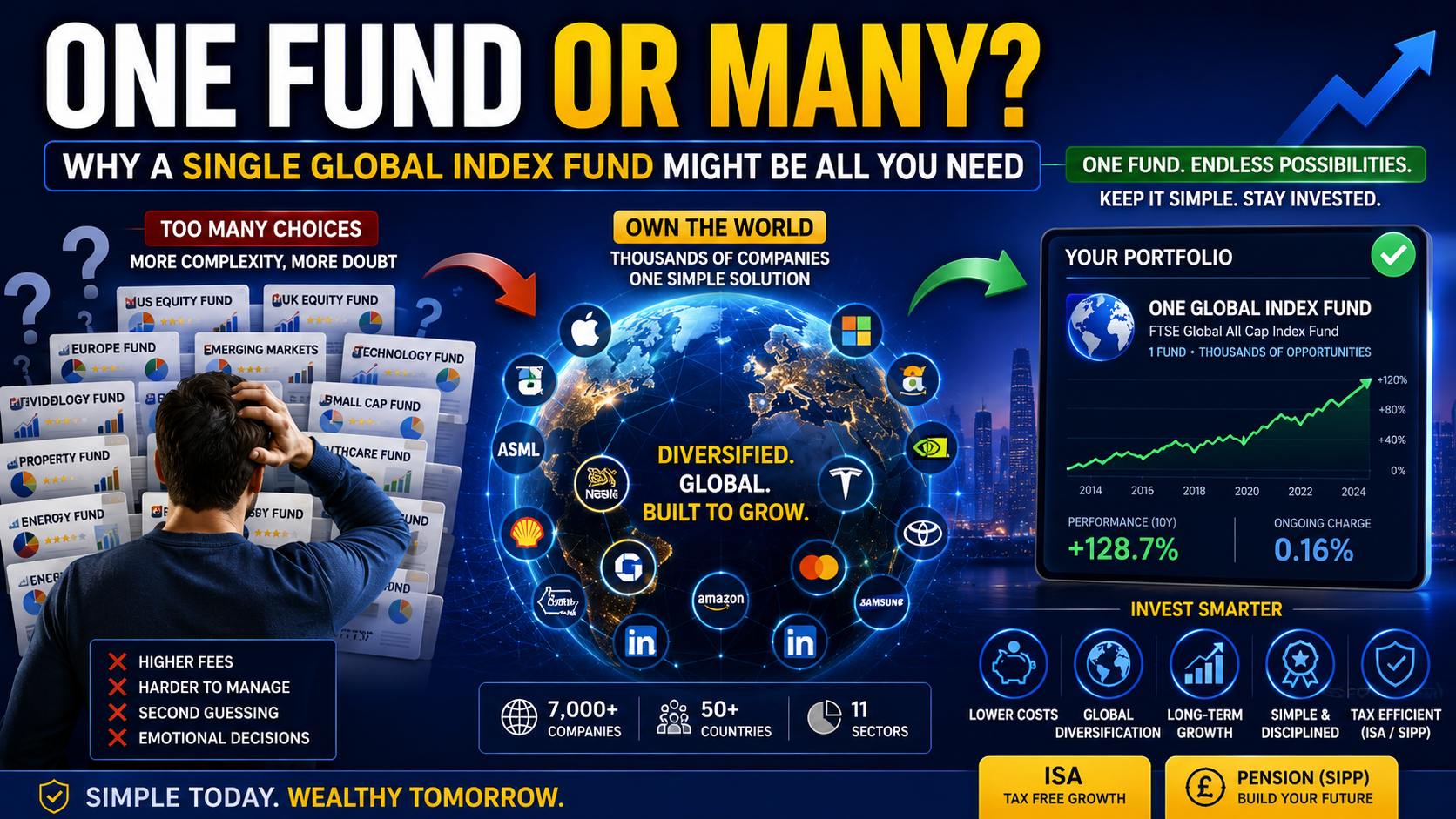
A growing number of investors are embracing the idea that a single global index fund could be all they need. Rather than building a portfolio from multiple funds, they choose one diversified global tracker and allow it to do the heavy lifting.
For beginners who feel overwhelmed by choice, this approach offers simplicity, diversification and peace of mind.
What Is A Global Index Fund.
A global index fund is designed to track the performance of thousands of publicly listed companies around the world. Instead of selecting individual shares, the fund automatically invests in businesses across multiple countries, industries and sectors.
In practical terms, buying a single global index fund can instantly give an investor exposure to companies in the United States, the United Kingdom, Europe, Japan, Canada, Australia and emerging markets.
Many popular global index funds available to UK investors hold between 3,000 and 7,000 companies. The Vanguard FTSE Global All Cap Index Fund, for example, provides exposure to more than 7,000 stocks worldwide.
That means with a single investment, you effectively become a shareholder in businesses ranging from Apple and Microsoft to Nestlé, Toyota, AstraZeneca and thousands more.
Why Simplicity Often Wins.
There is a common belief that successful investing requires constant monitoring and complex portfolio construction. In reality, evidence increasingly suggests that simplicity can be a powerful advantage.
Every additional fund creates another decision. How much should you allocate? When should you rebalance? Should you increase exposure to one region and reduce another?
A single global index fund removes many of those decisions.
Instead of attempting to predict which country, sector or company will outperform next year, investors simply own a slice of the global economy.
John Bogle, founder of Vanguard and pioneer of index investing, famously encouraged investors to "buy the haystack" rather than search for the needle. The philosophy remains relevant decades later. Global index funds are built around that exact principle.
Diversification Without The Headache.
One of the strongest arguments for a single fund portfolio is diversification.
Diversification helps reduce the impact of poor performance from any single company, sector or region. Rather than relying on one investment succeeding, your money is spread across thousands of businesses.
Consider the alternative.
An investor who only buys UK shares gains exposure to roughly 500 to 600 companies through the FTSE All-Share Index.
A global tracker fund can provide exposure to several thousand companies worldwide, significantly broadening diversification.
This matters because leadership changes over time.
Japan dominated global markets during the late 1980s. The United States has led much of the past decade. Emerging markets have enjoyed periods of strong growth. Predicting the next winner is difficult.
Owning the world means you do not need to make that prediction.
Low Costs Can Make A Big Difference.
Investment costs might seem insignificant at first glance, but they can have a substantial impact over decades.
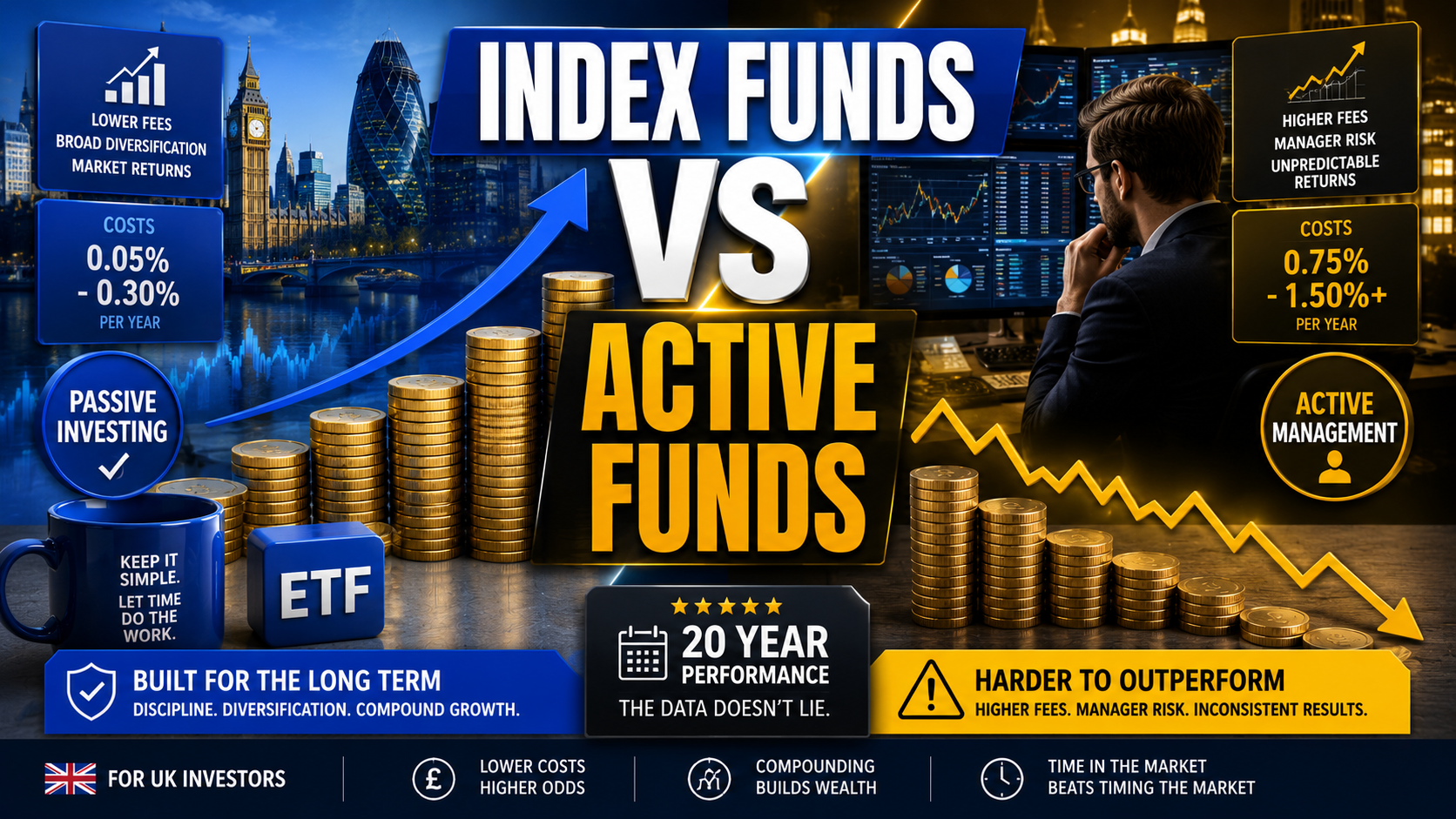
Global index funds are generally among the lowest-cost investments available because they simply track an index rather than employing teams of analysts to select stocks.
Popular global funds available to UK investors often charge between 0.12% and 0.23% annually.
That may not sound dramatic, but even small fee differences compound over time.
For a long-term investor contributing regularly for twenty or thirty years, lower fees can leave significantly more money invested and working towards future growth.
This focus on cost efficiency has helped fuel the popularity of passive investing. According to Investment Association data, index funds now account for approximately 35% of UK assets under management, their highest market share on record.
The Behavioural Advantage Most Investors Ignore.
The greatest benefit of a one-fund portfolio may not be diversification or low fees.
It may be behaviour.
Many investors struggle because they constantly tinker with their portfolios. They chase performance, react to headlines and attempt to time the market.
A simple portfolio creates fewer opportunities for mistakes.
When you own a single global index fund, there is less temptation to shift money between sectors or countries based on short-term news.
Instead, investors are encouraged to focus on what they can control:
- Saving regularly.
- Keeping costs low.
- Staying invested.
- Thinking long term.
Research consistently shows that investor behaviour often has a greater impact on outcomes than fund selection itself.
Sometimes the hardest part of investing is simply doing nothing.
Is One Fund Really Enough.
For many investors, the answer is yes.
A global index fund already contains exposure to thousands of companies across developed and emerging markets. It includes businesses from technology, healthcare, finance, consumer goods, industrials and many other sectors.
That level of diversification means many investors can comfortably build an entire equity portfolio around a single fund.
Of course, there are situations where additional investments may be appropriate.
Investors approaching retirement may want to include bonds for stability. Some may prefer a dedicated income strategy. Others may have specific financial goals requiring a different asset mix.
However, for younger investors focused on long-term growth, a global index fund often provides a strong foundation without unnecessary complexity.
Why This Approach Appeals To UK Beginners.
UK investors face an overwhelming number of choices.
There are Stocks and Shares ISAs, SIPPs, ETFs, mutual funds, investment trusts and robo-advisers. Each platform presents hundreds or even thousands of investment options.
That abundance of choice can become a barrier.
A single global fund provides a straightforward answer to a common beginner question:
"Where should I start?"
Instead of spending months comparing dozens of funds, investors can focus on building good habits and contributing consistently.
The simplicity also works well inside tax-efficient accounts such as Stocks and Shares ISAs and SIPPs, where investments can grow free from UK capital gains tax and dividend tax. Many global index funds are available within both account types.
The Bigger Picture.
The UK investment industry continues to grow rapidly, with assets under management reaching approximately £10 trillion. At the same time, demand for low-cost passive investing solutions continues to increase.
That trend reflects a broader shift in how investors think.
Rather than attempting to outsmart markets, many are choosing to participate in them.
A single global index fund is not exciting. It will not generate headlines. It will not promise overnight wealth.
What it can offer is something arguably more valuable.
A simple, diversified and low-cost way to participate in the growth of thousands of businesses around the world without spending hours analysing markets or managing multiple funds.
For beginners feeling overwhelmed by investment choices, that simplicity may be exactly what makes investing achievable in the first place.
If you're just starting out, subscribe and download our free eBook, Investing for Beginners Handbook, packed with practical tips to help you invest with confidence.