If you've spent any time researching investing, you've probably come across terms like FTSE 100, S&P 500, global tracker fund or index fund. For many beginners, these phrases can sound technical and intimidating. In reality, the concept behind them is surprisingly simple.
Understanding stock market indices is one of the most important steps for anyone starting their investing journey. Whether you're investing through an ISA, a pension or a general investment account, chances are your money will eventually be linked to one or more of these indices.
This guide explains what an index is, how major indices work, and why millions of investors choose tracker funds that follow them.
What Is a Stock Market Index?
A stock market index is simply a collection of companies grouped together to measure the performance of a particular section of the stock market.
Think of it as a scoreboard. Rather than checking the performance of hundreds or thousands of individual companies, an index gives investors a snapshot of how a market is performing overall.
For example, if the FTSE 100 rises by 1%, it means the combined value of the UK's 100 largest listed companies has increased. If the S&P 500 falls by 2%, it means the overall value of the companies within that index has declined by roughly that amount.
Indices themselves cannot be bought directly. Instead, investors typically use tracker funds or exchange traded funds (ETFs) that aim to replicate an index's performance.
Why Do Indices Matter?
Indices serve several important purposes.
Firstly, they provide a benchmark. Investors can compare their own portfolio performance against a recognised market standard.
Secondly, they make investing simpler. Rather than researching and selecting dozens of individual shares, investors can buy a tracker fund that automatically follows an index.
Finally, indices help investors diversify. Instead of relying on the fortunes of a handful of companies, they gain exposure to hundreds or even thousands of businesses.
This diversification is one reason passive investing has become increasingly popular. Tracker funds now account for around 23.5% of all investment fund assets, reflecting growing demand for low-cost investing solutions.
The FTSE 100 Explained.
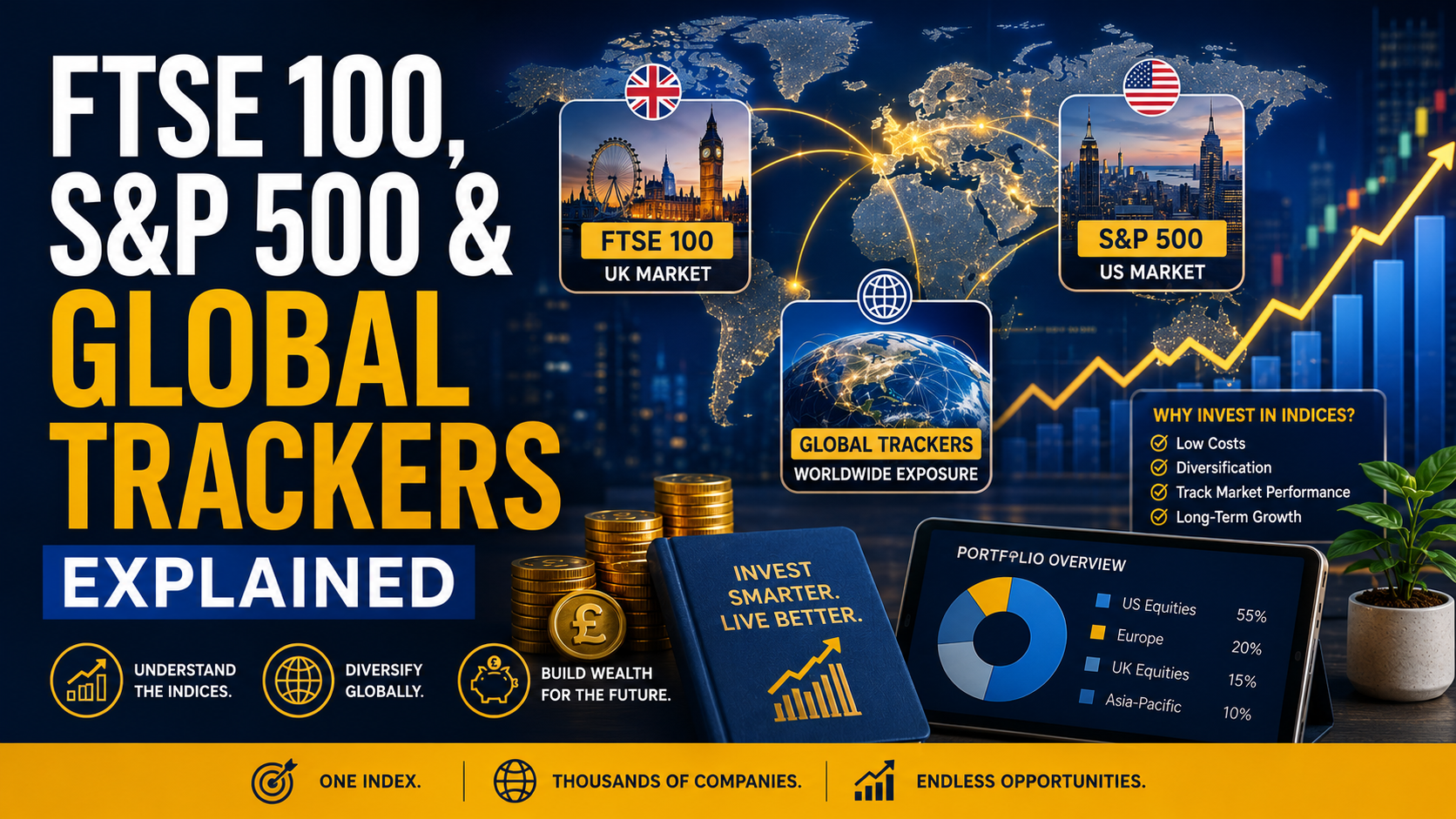
The FTSE 100 is the UK's best-known stock market index.
Often referred to as the "Footsie", it contains the 100 largest companies listed on the London Stock Exchange. Constituents are reviewed quarterly to ensure the index continues to represent the UK's biggest publicly traded businesses.
Some well-known FTSE 100 companies include:
- Shell
- HSBC
- AstraZeneca
- Unilever
- Rolls-Royce
- BP
One fact that surprises many investors is that a large proportion of FTSE 100 company revenues come from overseas markets. Although it is considered a UK index, many constituent companies generate significant income globally.
The FTSE 100 is often associated with income investing because many of its companies pay attractive dividends. This has helped make FTSE tracker funds popular among investors seeking long-term income and growth.
Recent years have also highlighted the index's resilience. The FTSE 100 delivered a return of approximately 24.7% during 2025 and reached record highs above 10,000 points in early 2026.
The S&P 500 Explained.
While the FTSE 100 dominates UK financial headlines, the S&P 500 is arguably the most influential stock market index in the world.
The S&P 500 contains 500 leading US companies and represents approximately 80% of the available market capitalisation of the US stock market.
Companies within the S&P 500 include:
- Apple
- Microsoft
- Nvidia
- Amazon
- Alphabet
- Meta
Because the United States hosts many of the world's largest technology companies, the S&P 500 has delivered exceptional long-term growth.
According to Fidelity, the S&P 500 has produced an average annual return of around 10.4% over the past 30 years when dividends are included.
More recently, the index returned approximately 17% during 2025 depending on the calculation method used.
For UK investors, the S&P 500 offers exposure to some of the world's most innovative and profitable businesses. However, it is worth remembering that investing solely in the S&P 500 means concentrating your portfolio in one country.
What Is a Global Tracker Fund?
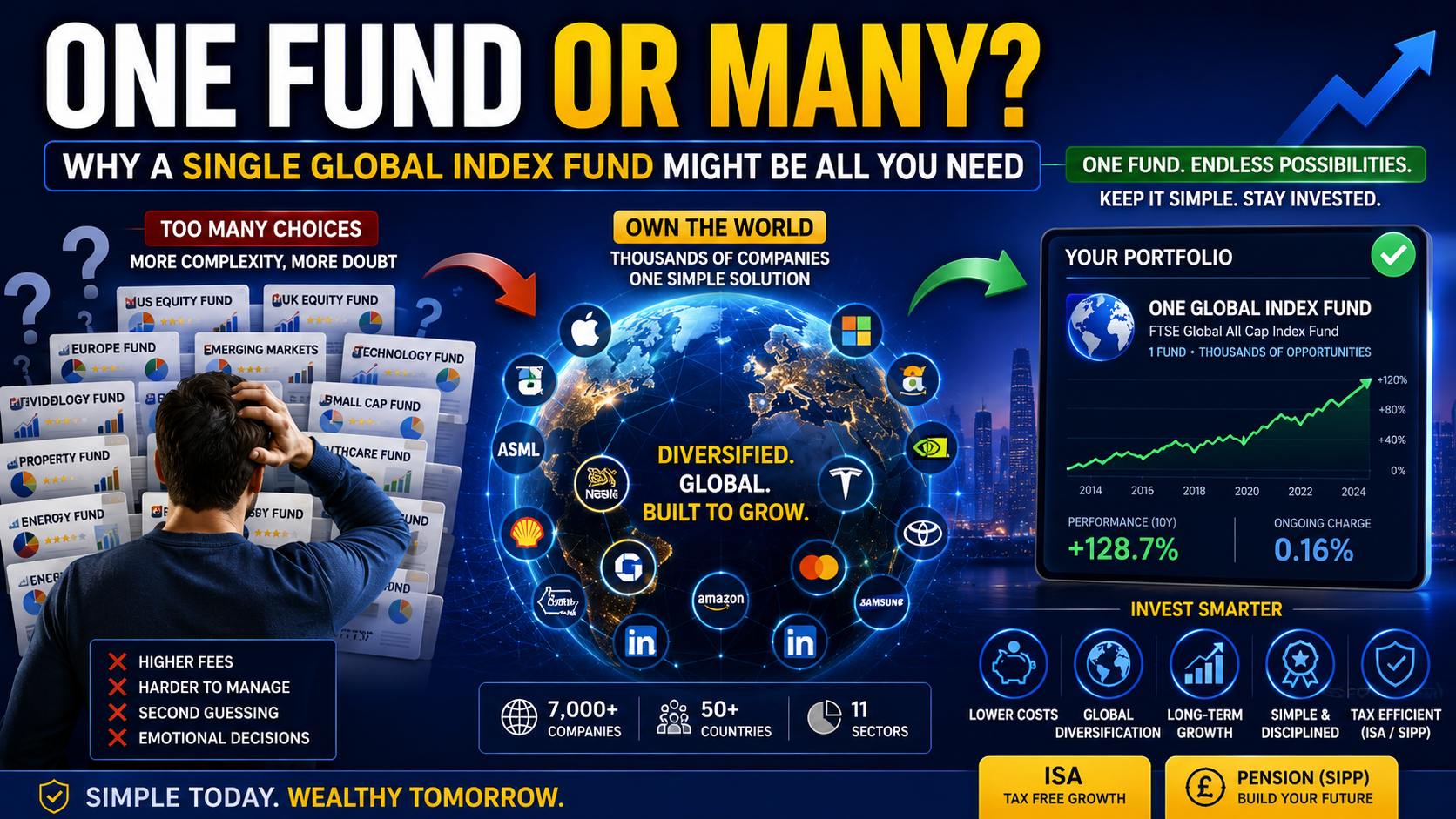
A global tracker fund takes diversification one step further.
Rather than following a single country or region, global trackers invest across multiple markets around the world.
Popular global indices often include companies from:
- The United States
- The United Kingdom
- Europe
- Japan
- Canada
- Australia
- Emerging markets
Depending on the index used, investors may gain exposure to more than 1,000 companies through a single fund.
Examples of widely followed global benchmarks include:
- FTSE Global All Cap Index
- FTSE All-World Index
- MSCI World Index
- MSCI ACWI Index
For beginners, global tracker funds are often viewed as one of the simplest investing solutions available. A single purchase can provide exposure to thousands of businesses across numerous industries and countries.
How Do Tracker Funds Follow an Index?
Tracker funds are designed to mirror the performance of a specific index.
If the index rises by 8%, the fund aims to rise by roughly the same amount, minus any fees and costs.
Most tracker funds achieve this by holding the same companies that make up the underlying index.
For example, an FTSE 100 tracker fund will own shares in FTSE 100 companies. An S&P 500 tracker fund will hold shares in S&P 500 constituents.
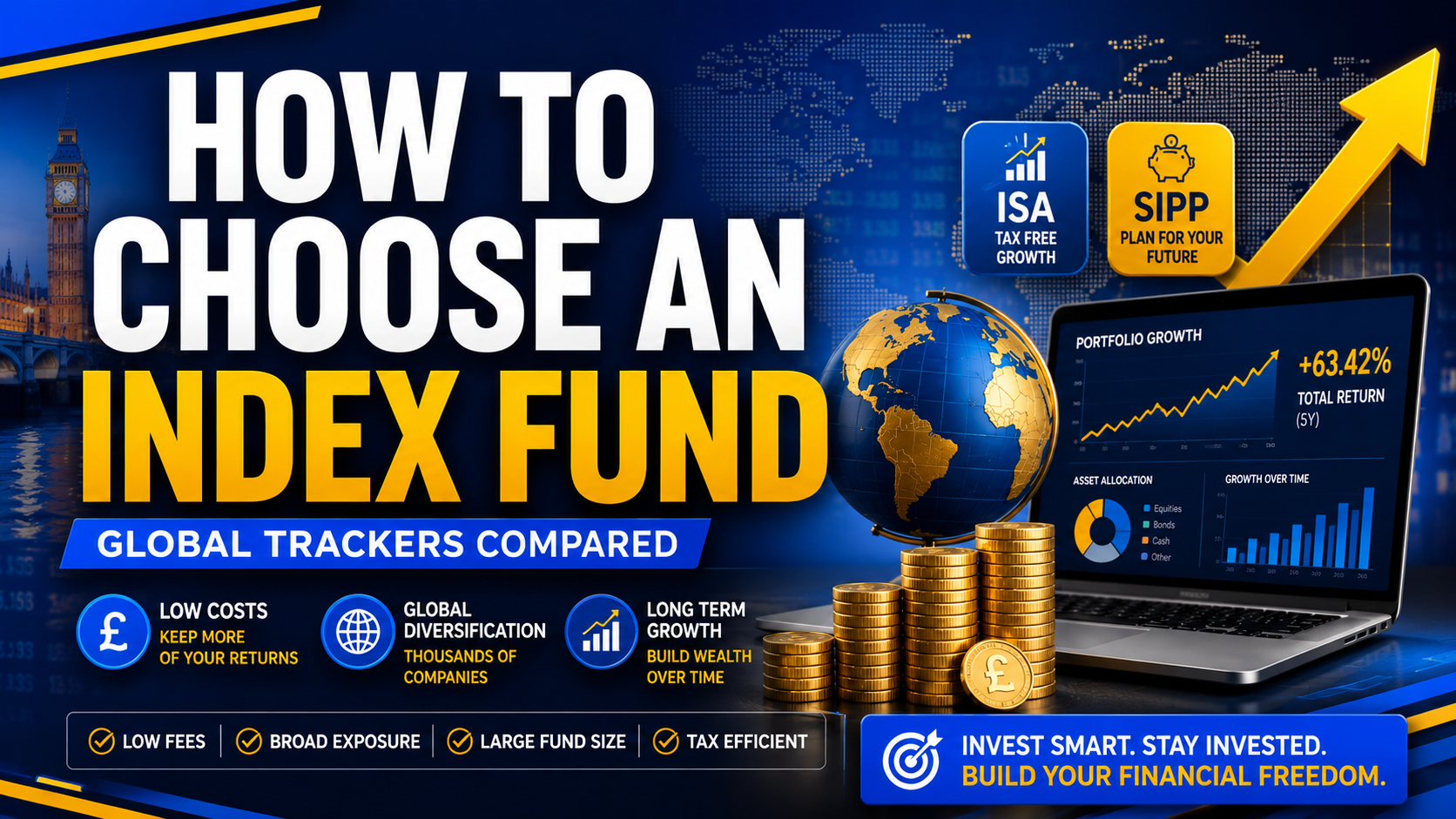
Because these funds simply follow an index rather than employing teams of fund managers to select stocks, they often have significantly lower fees than actively managed funds.
This cost advantage can have a meaningful impact on long-term investment returns.
Which Index Is Best for UK Investors?
There is no universal answer because every investor has different goals and risk tolerances.
Investors seeking UK exposure may prefer the FTSE 100.
Those wanting exposure to America's largest companies may favour the S&P 500.
Others may prefer the broader diversification offered by a global tracker fund.
Many experienced investors combine multiple indices within a portfolio to balance growth opportunities and geographical diversification.
A growing number of UK investors are also using Stocks and Shares ISAs to build wealth through index investing. Recent data shows a sharp rise in ISA millionaires, helped by strong market performance and the power of long-term compounding.
Common Mistakes New Investors Make.
One of the biggest mistakes beginners make is assuming all indices perform similarly.
Different indices can behave very differently depending on economic conditions.
The FTSE 100 tends to have greater exposure to sectors such as energy, financials and consumer goods.
The S&P 500 has a much larger weighting towards technology companies.
Global trackers provide broader diversification but may still be heavily influenced by the US market because American companies represent a significant share of global market capitalisation.
Another common mistake is focusing too heavily on short-term market movements. Successful index investing is usually built around long-term consistency rather than trying to predict market highs and lows.
Why Indices Are Central to Modern Investing.
Over the last two decades, index investing has transformed the way millions of people build wealth.
Instead of trying to identify tomorrow's winning stock, investors can own entire markets through low-cost tracker funds.
The approach is simple, transparent and easy to understand. It also removes much of the emotion that often leads investors to make poor decisions.
Whether you choose the FTSE 100, the S&P 500 or a global tracker fund, understanding what an index is gives you a strong foundation for making smarter investment decisions and building long-term wealth.
Want to learn the basics of investing step-by-step? Subscribe today and get your free copy of the Investing for Beginners Handbook.