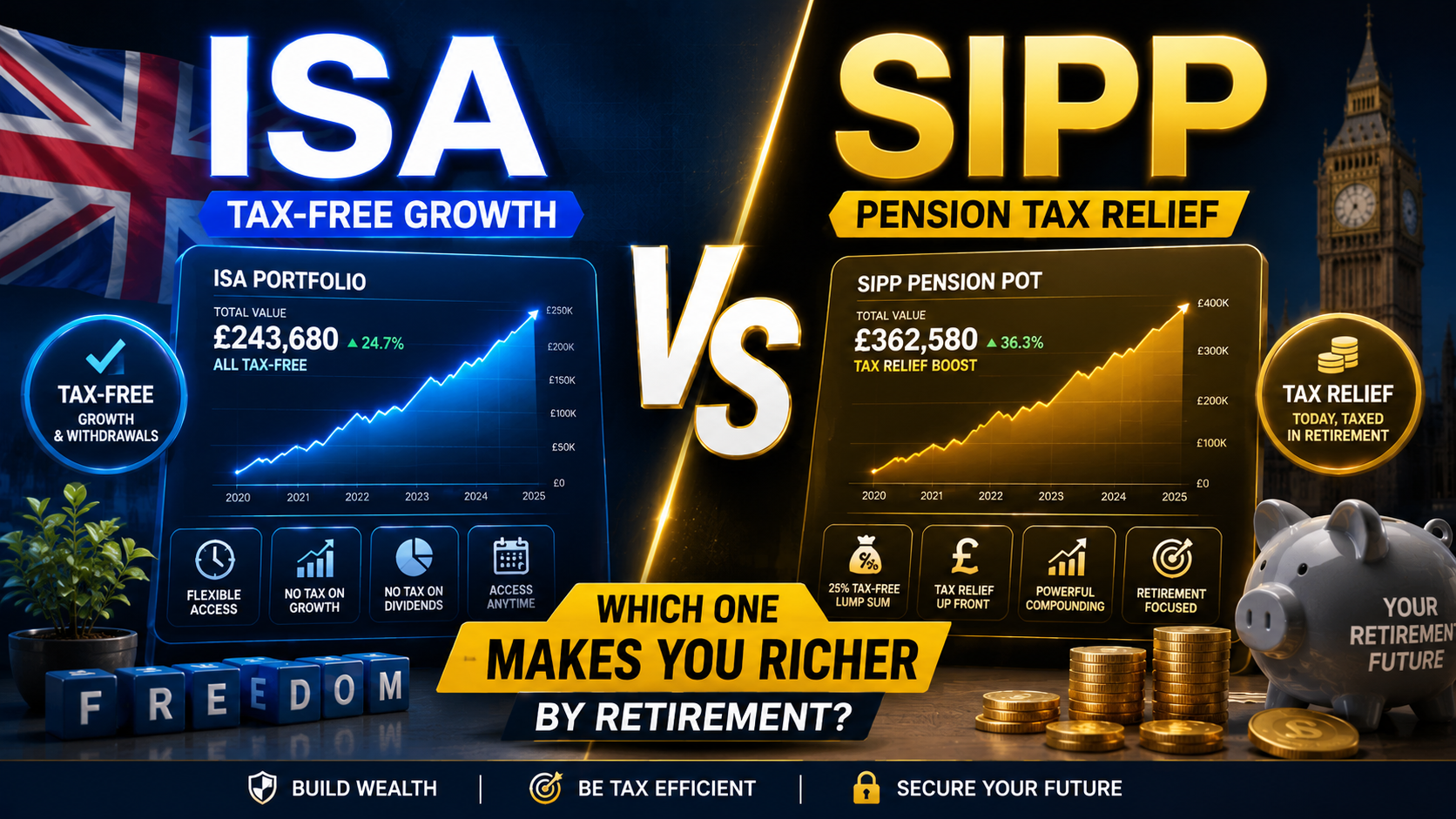
For UK investors building long-term wealth, few questions generate more debate than whether a Stocks and Shares ISA or a Self-Invested Personal Pension (SIPP) is the better home for their money.
Both offer powerful tax advantages. Both can hold the same investments, including index funds, ETFs and individual shares. Both can help you build substantial wealth over decades.
Yet despite their similarities, they are designed for different purposes. One rewards you heavily for locking money away until retirement. The other gives you complete flexibility and tax-free access whenever you need it.
So which one actually makes you richer by retirement?
The answer is more nuanced than many headlines suggest.
Why This Comparison Matters More Than Ever.
The popularity of both ISAs and pensions continues to grow across the UK. HMRC data shows that contributions into adult ISAs reached a record £103 billion during the 2023-24 tax year, spread across approximately 15 million subscribed accounts.
Meanwhile, pension tax relief remains one of the most generous incentives available to UK savers. HMRC estimates that pension tax relief and related benefits cost tens of billions of pounds annually, highlighting just how valuable these incentives can be for investors.
With rising life expectancy, uncertainty around State Pension provision and increasing awareness of financial independence strategies, understanding the differences between ISAs and SIPPs has become essential for anyone serious about retirement planning.
The Key Difference: Tax Relief Versus Tax-Free Access.
At first glance, ISAs and SIPPs appear remarkably similar.
Both allow investments to grow free from capital gains tax. Both shelter dividend income from taxation. Both can hold a wide range of investments.
The major distinction lies in when you receive the tax benefit.
With a Stocks and Shares ISA, you invest money after tax has already been paid. In return, all future growth, dividends and withdrawals are completely tax-free.
With a SIPP, you receive tax relief on contributions today, but some tax may be payable when you eventually withdraw the money.
This difference creates one of the most powerful wealth-building advantages available to UK investors.
How Pension Tax Relief Creates a Head Start.
Suppose a basic-rate taxpayer wants to invest £8,000.
If they place that money into a SIPP, the government automatically adds £2,000 in pension tax relief. That means £10,000 enters the investment account.
A higher-rate taxpayer could potentially receive even more relief through self-assessment, making the effective contribution cost significantly lower.
That extra capital has decades to compound.
Assuming a 7% annual return over 30 years:
- £8,000 growing at 7% becomes approximately £60,900
- £10,000 growing at 7% becomes approximately £76,100
The pension starts with a substantial advantage before any investment performance is considered.
This is why SIPPs often appear to win every comparison.
However, the story does not end there.
The Catch: Pension Money Is Not Fully Tax-Free.
When you eventually access a SIPP, the rules change.
Currently, most pension holders can take 25% of their pension tax-free. The remaining 75% is generally taxed as income when withdrawn.
For many retirees, this may not be a major issue because retirement income often falls within lower tax bands than during working life.
However, it does mean the headline tax advantage is not quite as large as it first appears.
An ISA works differently.
Every pound withdrawn from a Stocks and Shares ISA is tax-free. There is no income tax bill, no reporting requirements and no concerns about tax bands.
This flexibility can become incredibly valuable later in life.
Access Age Could Be the Deciding Factor.
One of the most overlooked aspects of the ISA versus SIPP debate is access.
You can access ISA money whenever you choose.
A SIPP is designed specifically for retirement.
The normal minimum pension access age is currently 55 for many investors and is scheduled to rise to 57 from 2028 for most people. Pension legislation can also change over time.
For someone planning to retire early, this distinction becomes critical.
Imagine reaching financial independence at age 50.
A large SIPP balance may look impressive on paper, but it does not help much if you cannot access it for several years.
This is why many FIRE investors build wealth using both vehicles simultaneously.
The FIRE Community's Favourite Strategy.
Financial Independence, Retire Early enthusiasts rarely view ISA and SIPP as competing products.
Instead, they often use them together.
The ISA acts as a bridge account.
It provides accessible wealth that can fund living expenses before pension access becomes available.
The SIPP acts as the long-term retirement engine.
The combination allows investors to benefit from pension tax relief while still maintaining flexibility.
For many people pursuing early retirement, this blended strategy offers the best of both worlds.
What the Numbers Suggest.
Let's compare two investors.
Investor A contributes £500 monthly into a Stocks and Shares ISA.
Investor B contributes the equivalent amount into a SIPP and receives basic-rate tax relief.
Assuming a 7% annual return over 30 years:
The ISA investor contributes £180,000 and could accumulate around £610,000.
The SIPP investor effectively sees £625 entering the account each month after tax relief. Over the same period, the pot could exceed £760,000.
Even after accounting for taxation on future withdrawals, the pension often retains a meaningful advantage.
This explains why financial planners frequently describe pensions as the most powerful retirement savings vehicle available to UK workers.
Who Is Better Suited to an ISA.
An ISA tends to suit investors who prioritise flexibility.
It may be the stronger choice if you:
- Want unrestricted access to your money
- Plan to retire before pension access age
- Need funds for major life goals
- Have already maximised pension contributions
- Value simplicity and tax-free withdrawals
ISAs also provide peace of mind because future governments are generally less likely to restrict access to money you already own outright.
That certainty carries value which cannot easily be measured in a spreadsheet.
Who Is Better Suited to a SIPP.
A SIPP is often the superior choice for investors focused primarily on retirement wealth.
It may be particularly attractive if you:
- Pay higher-rate or additional-rate tax
- Have a long investment horizon
- Want maximum tax efficiency
- Receive employer pension contributions
- Do not expect to need the money before retirement
Employer contributions deserve special attention.
If your employer matches pension contributions, turning down that match is effectively rejecting free money.
In most cases, employer matching should be prioritised before additional ISA investing.
What Most Wealthy Investors Actually Do.
Interestingly, many experienced investors do not choose one or the other.
They use both.
A common approach looks like this:
First, contribute enough to secure the full employer pension match.
Second, maximise available pension tax relief where appropriate.
Third, build ISA investments to create flexibility and bridge retirement gaps.
This approach reduces reliance on future tax policy while capturing the advantages of both systems.
It also creates multiple sources of retirement income, which can improve tax efficiency later in life.
So Which One Makes You Richer by Retirement.
Purely from a mathematical perspective, the SIPP often wins.
The upfront tax relief provides a powerful boost that can compound for decades. For higher-rate taxpayers, the advantage can be even greater.
However, wealth is not just about account balances.
Financial freedom is also about flexibility, access and control.
A large pension pot may look impressive, but accessible wealth can sometimes provide more practical value, especially for those pursuing early retirement or major life goals before traditional retirement age.
For many UK investors, the real answer is not ISA or SIPP.
It is ISA and SIPP.
Used together, they create a tax-efficient strategy that combines the growth potential of pension tax relief with the flexibility of tax-free withdrawals. That combination can provide both a larger retirement fund and greater freedom along the journey.
Want to build wealth more tax efficiently? Subscribe and get your free copy of the UK Tax-Efficient Investing Playbook delivered straight to your inbox.