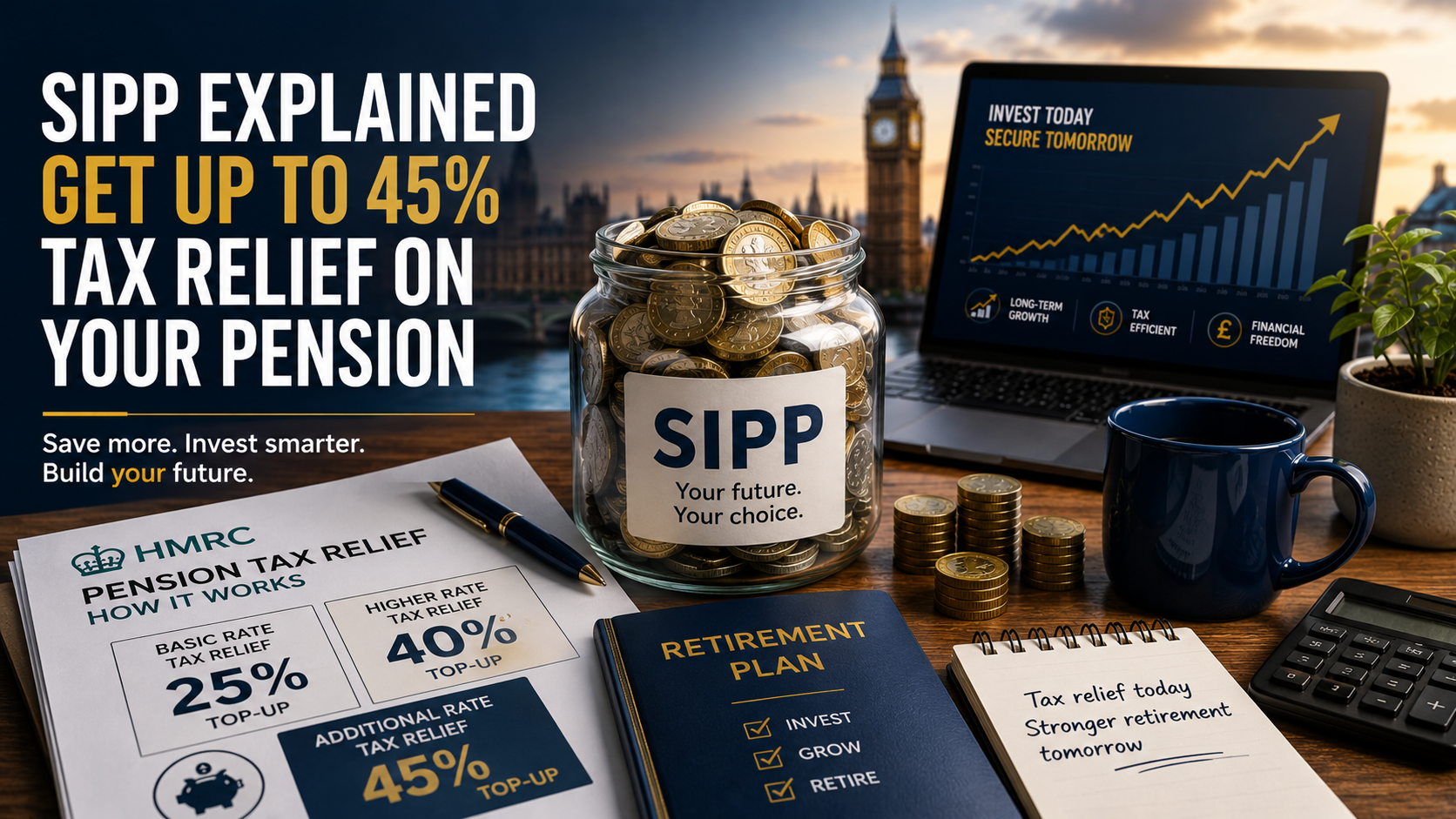
For many UK investors, a Self-Invested Personal Pension (SIPP) is one of the most powerful tools available for building long-term wealth. While the flexibility to choose your own investments often gets the headlines, the real attraction is often the generous tax relief available on contributions.
In simple terms, the government effectively rewards you for saving towards retirement. Depending on your tax band, a pension contribution can receive a top-up worth 20%, 40%, or even 45%, making it one of the most tax-efficient ways to invest for the future.
Yet despite the substantial benefits, many higher-rate taxpayers fail to claim all the pension tax relief they are entitled to receive. Understanding how the system works could potentially add thousands of pounds to your retirement savings over time.
What Is A SIPP?
A Self-Invested Personal Pension is a type of personal pension that allows you to choose and manage your own investments.
Unlike some workplace pensions that offer a limited selection of funds, a SIPP typically provides access to a much wider range of investments, including:
- Investment funds
- Exchange-traded funds (ETFs)
- Individual shares
- Investment trusts
- Bonds
- Cash holdings
This flexibility has made SIPPs increasingly popular among investors who want greater control over how their retirement savings are invested.
However, the tax advantages are often the biggest reason people choose to contribute to a SIPP.
How Pension Tax Relief Works.
The government provides tax relief on pension contributions to encourage long-term retirement saving.
For most SIPPs, pension contributions operate under a system known as "relief at source".
This means that when you contribute money into your pension, your provider automatically claims basic-rate tax relief from HMRC.
For example:
- You contribute £80.
- HMRC adds £20.
- Your pension receives £100.
This means every £80 contribution receives a 25% boost from the government before it is invested.
For basic-rate taxpayers, this is generally the full amount of tax relief available.
Why Higher-Rate Taxpayers Can Get More.
The pension system is designed to provide relief at your highest marginal rate of income tax.
If you pay higher-rate tax at 40%, you are entitled to 40% pension tax relief.
If you pay additional-rate tax at 45%, you are entitled to 45% pension tax relief.
The catch is that most SIPP providers only add the basic 20% relief automatically.
Any additional relief must usually be claimed directly from HMRC.
This is where many investors miss out.
According to analysis of HMRC data, around £1.3 billion of pension tax relief went unclaimed over a five-year period because eligible higher and additional-rate taxpayers failed to claim what they were owed.
A Real Example Of 40% Pension Tax Relief.
Suppose Sarah earns £65,000 per year and wants to contribute £10,000 into her SIPP.
She pays £8,000 into the pension.
Her SIPP provider claims £2,000 from HMRC.
The pension receives the full £10,000 contribution.
Because Sarah is a higher-rate taxpayer, she can claim a further £2,000 through HMRC.
As a result:
- Pension contribution: £10,000
- Total tax relief: £4,000
- Actual cost to Sarah: £6,000
In effect, the government contributes £4,000 towards her retirement savings.
How Additional-Rate Tax Relief Works.
The benefit becomes even more powerful for additional-rate taxpayers.
If David pays income tax at 45% and contributes £10,000 to a SIPP:
- £8,000 is paid by David.
- £2,000 is added automatically.
- David can claim an additional £2,500.
The result is that a £10,000 pension contribution can effectively cost him just £5,500.
This represents one of the most generous tax incentives available to UK investors today.
How To Claim Higher-Rate Pension Tax Relief.
If your pension operates under relief at source, you will usually need to claim the additional tax relief yourself.
There are two common methods.
If you already complete a Self Assessment tax return, you simply enter your gross pension contributions into the relevant section of the return.
HMRC will calculate the additional relief automatically.
If you do not complete Self Assessment, you can contact HMRC directly and request the additional relief.
Depending on your circumstances, HMRC may:
- Adjust your tax code
- Issue a tax refund
- Reduce a future tax bill
Claims can generally be backdated for up to four tax years, meaning some investors could be sitting on significant unclaimed refunds.
Why More People Need To Pay Attention.
The number of higher-rate taxpayers in the UK continues to grow.
Recent figures suggest that more than seven million people are expected to pay higher-rate income tax, largely due to frozen tax thresholds and rising wages.
At the same time, many people remain unaware of how pension tax relief works.
Research highlighted by MoneyWeek found that 88% of UK adults did not know the exact rate of pension tax relief they receive, while nearly one-third were unaware that pension contributions receive tax relief at all.
This lack of awareness helps explain why so much relief goes unclaimed each year.
Pension Tax Relief Is Worth Billions.
The scale of pension tax incentives in the UK is enormous.
HMRC estimates show pension tax relief costs the government tens of billions of pounds annually, reflecting the significant support provided to retirement savers.
Recent HMRC statistics also show that 56% of income tax relief on pension contributions is received at the higher-rate level, while 7% is received at the additional-rate level.
These figures highlight how valuable pension planning can be for individuals paying higher rates of income tax.
Other Benefits Of Contributing To A SIPP.
Tax relief is only part of the story.
Investments held inside a SIPP can grow free from capital gains tax and dividend tax, allowing more of your returns to remain invested over the long term.
For investors with decades until retirement, this tax-efficient growth can have a substantial impact on final pension values.
Many investors also use SIPPs alongside Stocks and Shares ISAs to create a diversified and tax-efficient long-term investment strategy.
While ISAs provide tax-free withdrawals, pensions offer valuable upfront tax relief. Combining both can provide flexibility throughout retirement.
Understanding Contribution Limits.
Most people can receive tax relief on pension contributions up to 100% of their earnings each year, subject to the annual allowance.
For many investors, the standard annual allowance currently stands at £60,000.
Those with unused allowance from previous years may also be able to carry forward unused allowances, potentially allowing larger contributions while still benefiting from tax relief.
Because pension rules can be complex, investors making substantial contributions should consider seeking regulated financial advice.
Why SIPPs Remain One Of The Most Powerful Retirement Tools.
Building wealth for retirement is rarely about finding the perfect investment.
More often, it is about consistently investing over many years while making full use of available tax allowances.
A SIPP combines investment flexibility with some of the most attractive tax incentives available in the UK financial system.
Whether you are a basic-rate taxpayer receiving a 25% boost on contributions or a higher earner able to secure relief worth up to 45%, understanding how pension tax relief works can significantly improve your long-term retirement outcomes.
For many investors, ensuring every available pound of tax relief is claimed could be one of the smartest financial decisions they make before retirement.
Want to learn more about building wealth tax-efficiently? Subscribe and get your free copy of the UK Tax-Efficient Investing Playbook today.
Keep reading: ISA vs SIPP: Which One Makes You Richer by Retirement? and What Is an Index Fund? A Beginner’s Guide to Passive Investing.