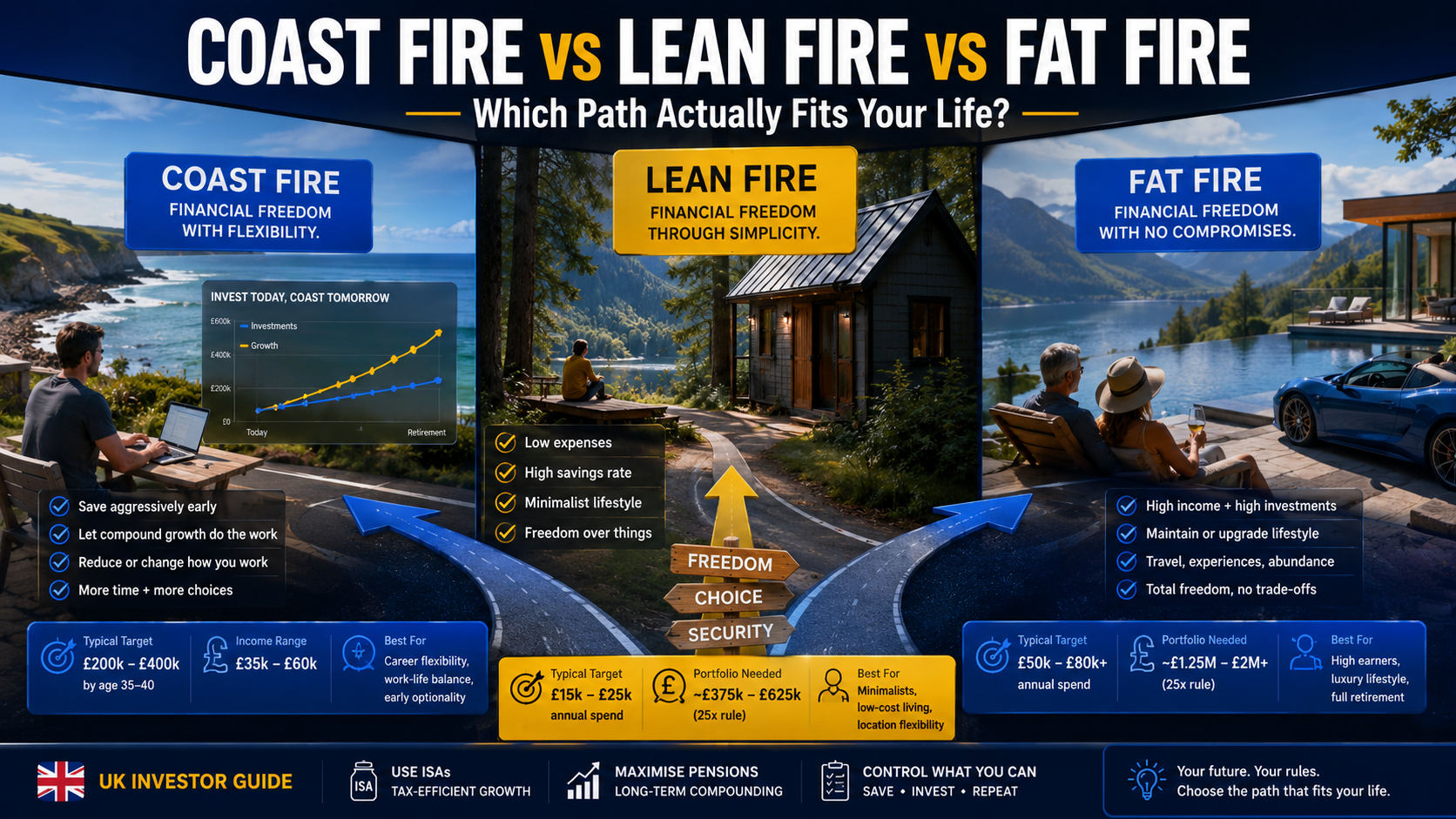
The Financial Independence, Retire Early (FIRE) movement has gained significant traction in the UK over the past decade. More people are looking for ways to build investment portfolios, reduce expenses and create enough passive income to leave full-time employment years before the traditional retirement age.
One question frequently arises among aspiring early retirees. What role does the State Pension play in a FIRE strategy?
While many FIRE enthusiasts focus heavily on ISAs, SIPPs, index funds and dividend investing, the State Pension remains one of the most valuable retirement benefits available to UK residents. Understanding when it becomes available, how much it is worth and how it fits into an early retirement plan can make a substantial difference to long-term financial projections.
Why The State Pension Matters For FIRE Followers.
Many people pursuing FIRE deliberately exclude the State Pension from their calculations when determining their financial independence number. This conservative approach helps ensure they can retire early without relying on government benefits.
However, ignoring the State Pension entirely can sometimes result in overestimating the amount of money needed to achieve financial independence.
The State Pension effectively acts as a guaranteed income stream later in life. For many retirees, it reduces the amount they need to withdraw from investment portfolios after reaching State Pension age. This can improve the sustainability of a retirement plan and reduce the risk of running out of money during retirement.
For someone retiring at 50, there could be a gap of 16 years before State Pension payments begin. For someone retiring at 60, the wait could be considerably shorter. Either way, understanding this future income source is an important part of long-term planning.
How Much Is The UK State Pension Worth.
For the 2025-26 tax year, the full new State Pension is worth £230.25 per week, equivalent to approximately £11,973 per year. Eligibility generally requires at least 35 qualifying years of National Insurance contributions, while a minimum of 10 qualifying years is needed to receive any State Pension entitlement.
At first glance, nearly £12,000 per year may not seem life-changing. However, when viewed through the lens of retirement planning, the value becomes far more significant.
Financial planners often estimate retirement income value using withdrawal rates. Using a 4% withdrawal rate, generating £11,973 annually from investments would require a portfolio worth roughly £299,000.
In practical terms, a full State Pension can be viewed as being broadly equivalent to owning an investment portfolio worth around £300,000 that produces income throughout retirement.
For couples who both qualify for the full State Pension, the combined annual income exceeds £23,900. Using the same methodology, this could represent income similar to that generated by a portfolio worth almost £600,000.
This illustrates why the State Pension can play a major supporting role in a FIRE strategy, even if it does not begin until later in life.
When Does The State Pension Kick In.
The current State Pension age in the UK is 66.
However, legislation already provides for a gradual increase to age 67 between 2026 and 2028. A further increase to age 68 is currently planned for future decades, although exact timings may change following government reviews.
For those pursuing FIRE, this means retirement planning must account for a period where living expenses are funded entirely through personal savings and investments before State Pension payments begin.
Someone retiring at 50 may need investment assets to cover 16 years of expenses before State Pension eligibility.
Someone retiring at 60 may only need investments to bridge a six-year gap.
This distinction can have a major impact on the size of the portfolio required to retire comfortably.
The Triple Lock Advantage.
One of the most valuable features of the State Pension is the Triple Lock mechanism.
Under the Triple Lock, the State Pension increases each year by whichever is highest:
- Average earnings growth.
- Inflation.
- 2.5%.
This policy has helped protect pensioners from rising living costs and preserve purchasing power over time. The State Pension increased by 4.1% in April 2025 and is set to rise by a further 4.8% from April 2026 under current projections.
For FIRE investors, this inflation-linked characteristic is particularly valuable. Unlike many investment income sources, the State Pension automatically receives annual increases backed by government policy.
This can reduce pressure on retirement portfolios during periods of higher inflation.
How The State Pension Fits Into A FIRE Withdrawal Strategy.
A common FIRE approach involves drawing income from investment portfolios during the early retirement years and then reducing withdrawals once the State Pension begins.
Consider an individual who requires £30,000 per year to cover living expenses.
Between ages 50 and 66, the full £30,000 may need to come from investments.
After age 66, assuming a full State Pension entitlement, the portfolio may only need to provide approximately £18,000 annually.
Reducing withdrawals later in retirement can significantly improve portfolio longevity.
This approach allows many FIRE followers to retire earlier than they otherwise could because they know a guaranteed income source will eventually supplement their investment income.
National Insurance Contributions Are Worth Checking.
One area many people overlook is their National Insurance record.
A surprising number of individuals discover gaps in their contribution history due to periods of study, travel, caring responsibilities or lower earnings.
Checking your State Pension forecast through the Government Gateway can reveal whether additional qualifying years are required to achieve the full pension.
Since the State Pension can be worth the equivalent of hundreds of thousands of pounds in retirement income, filling contribution gaps often represents one of the best value financial decisions available.
Even small improvements in future pension entitlement can deliver significant long-term benefits.
Is The State Pension Enough On Its Own.
Despite its importance, the State Pension alone is rarely sufficient to fund a comfortable retirement.
Research suggests that the full State Pension currently provides around £11,973 annually, while a single pensioner typically requires approximately £13,400 per year to achieve a minimum retirement living standard.
The gap becomes much larger for those seeking a more comfortable lifestyle involving travel, hobbies and discretionary spending.
This is why workplace pensions, SIPPs, ISAs and investment portfolios remain essential components of most retirement plans.
For FIRE followers, the State Pension should generally be viewed as a valuable supplement rather than the primary source of retirement income.
Interesting State Pension Statistics UK Investors Should Know.
Several State Pension statistics highlight its importance within the UK retirement system.
Around 12.7 million people currently receive a State Pension in the UK, making it the largest single area of welfare expenditure. Annual spending on State Pensions is estimated at roughly £145 billion.
Nearly 13 million pensioners benefited from the 4.1% State Pension increase introduced in April 2025.
Approximately 1.2 million retired households rely primarily on State Pension income, underlining its role as a crucial financial safety net.
The State Pension remains one of the few retirement income sources that is backed directly by the UK government and protected through annual increases linked to the Triple Lock system.
These figures demonstrate why even financially independent investors should pay attention to their future entitlement.
Building A FIRE Plan Around Multiple Income Sources.
The strongest FIRE plans rarely depend on a single source of income.
Instead, they combine several streams that work together throughout retirement.
Investment portfolios may provide income in the early years. Workplace pensions and SIPPs can become available from minimum pension access ages. Finally, the State Pension can provide a valuable income floor later in life.
This layered approach helps spread risk and can improve long-term financial security.
For many investors, reaching financial independence is not about replacing every pound of future income immediately. It is about understanding how different assets and benefits interact over time to support a sustainable lifestyle.
The State Pension remains one of the most valuable pieces of that puzzle. While it may arrive later than many FIRE followers would like, its guaranteed nature, inflation protection and substantial lifetime value mean it deserves a place in almost every retirement plan.
Want to accelerate your investing journey? Subscribe today and receive our free eBook, Investing for Beginners Handbook, packed with practical strategies to help you build long-term wealth.