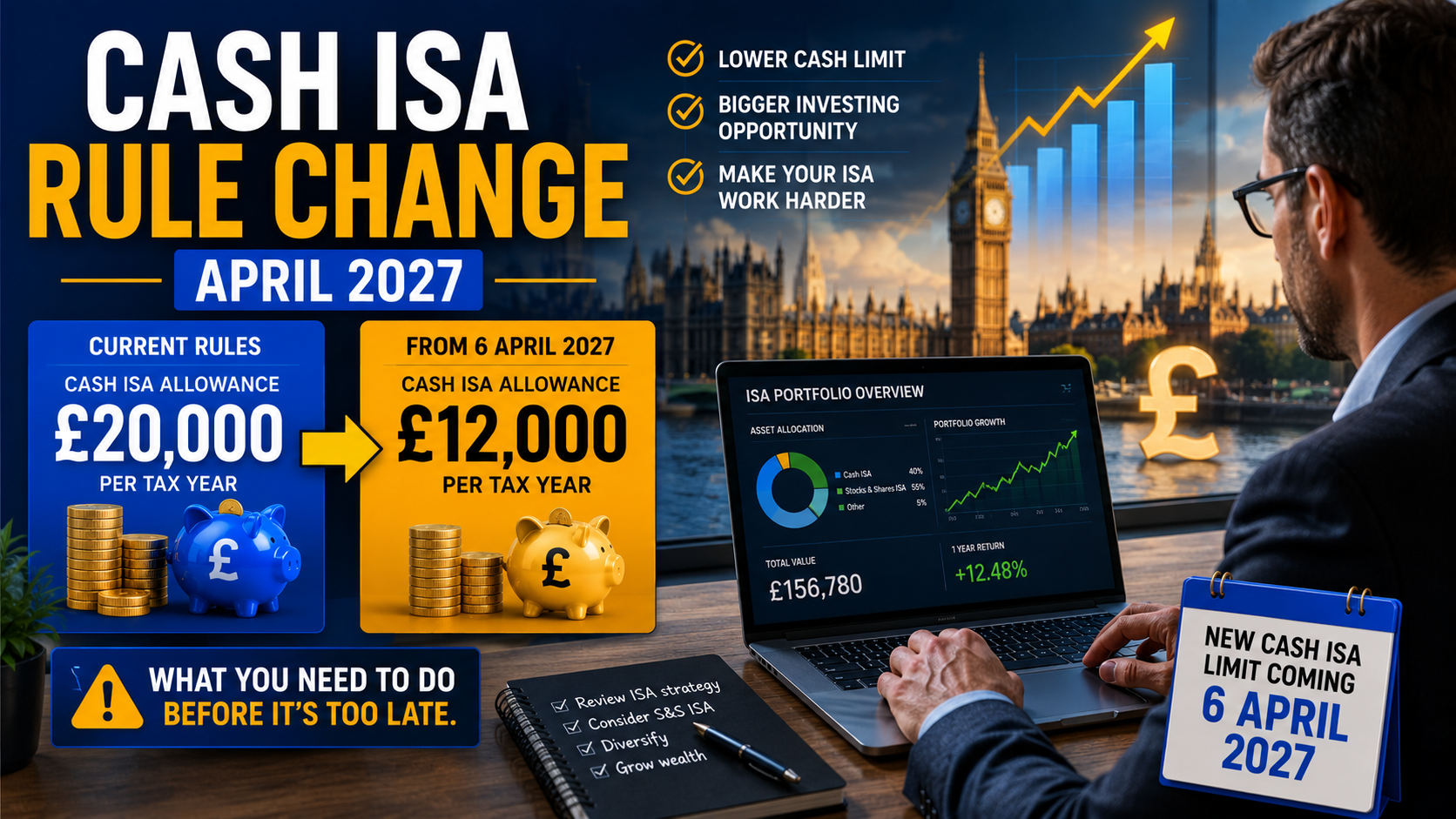
For millions of UK savers, the annual ISA allowance represents one of the most valuable tax-efficient opportunities available. Yet despite the potential for long-term growth, many people continue to favour Cash ISAs over Stocks and Shares ISAs.
The preference is understandable. Cash feels safe. Savings accounts are familiar. Stock markets can appear unpredictable and intimidating.
However, when money is left untouched for a decade or more, the decision between cash and investing can have a dramatic impact on future wealth.
The difference is not simply a few hundred pounds. In many cases, it can amount to tens of thousands of pounds.
So what happens if you place £20,000 into a Cash ISA compared with a Stocks and Shares ISA and leave it invested for 10 years?
The numbers tell a compelling story.
Understanding The Difference Between The Two ISAs.
Both Cash ISAs and Stocks and Shares ISAs offer tax-free growth and sit within the same annual ISA allowance of £20,000.
A Cash ISA works much like a traditional savings account. Your money earns interest and is protected from market fluctuations.
A Stocks and Shares ISA allows you to invest in funds, ETFs, shares and bonds. While values can rise and fall over shorter periods, investors benefit from the long-term growth potential of financial markets.
Importantly, neither ISA type attracts income tax, dividend tax or capital gains tax on returns, making both highly tax-efficient options for UK savers.
What £20,000 Could Become In A Cash ISA Over 10 Years.
Cash ISA rates have improved significantly since interest rates increased across the UK.
Many leading Cash ISAs currently offer rates around 4% to 5%, depending on whether the account is fixed or easy access.
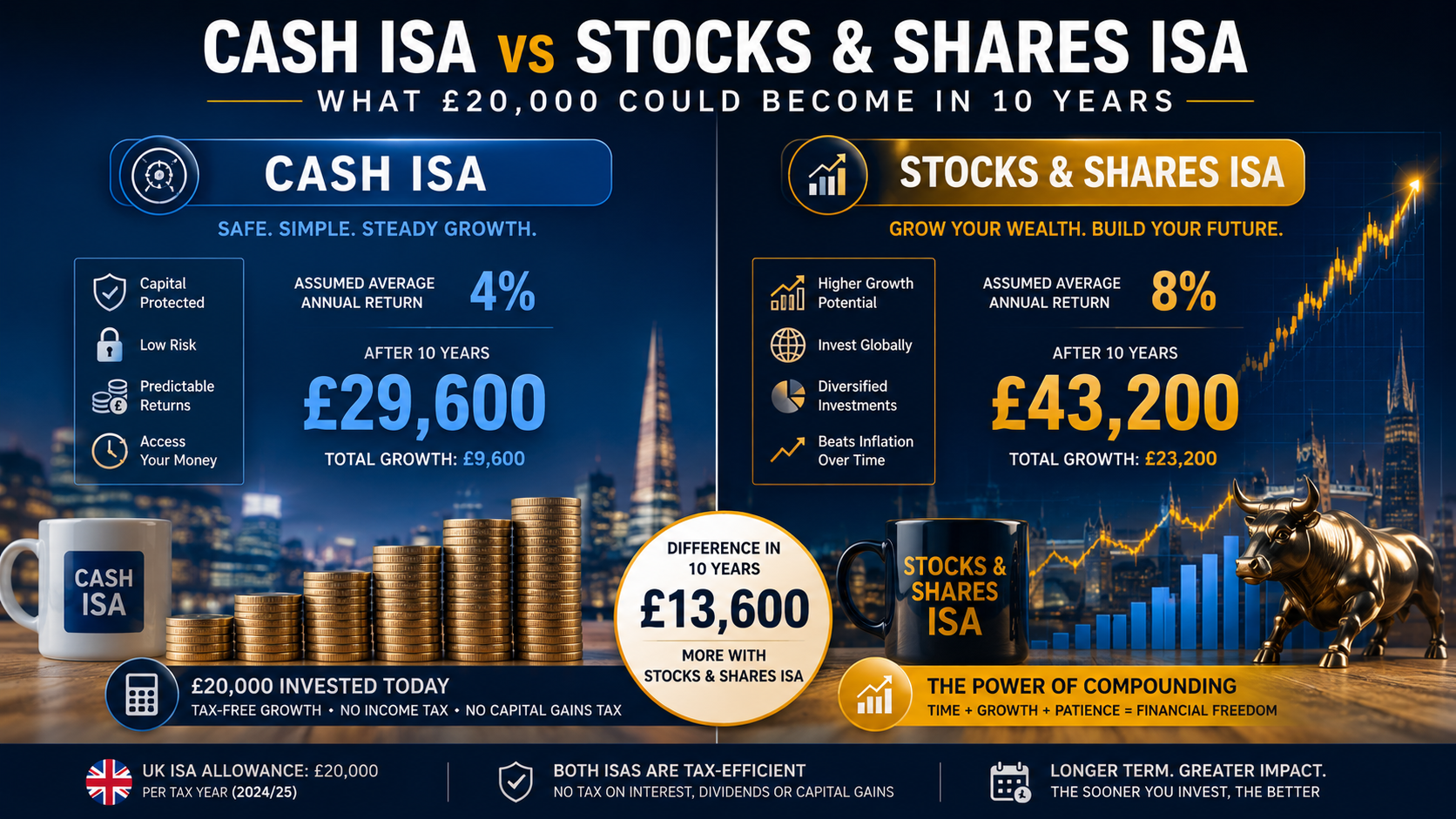
For illustration purposes, let's assume an average annual return of 4%.
Using compound interest, a £20,000 Cash ISA would grow to:
£20,000 invested at 4% for 10 years = approximately £29,600
That represents a gain of roughly £9,600 over the decade.
Not bad for a low-risk savings vehicle.
However, the story changes when compared with long-term investing.
What £20,000 Could Become In A Stocks And Shares ISA Over 10 Years.
Historical stock market returns vary depending on market conditions and the investments chosen.
Many globally diversified equity portfolios have historically delivered annual returns of around 7% to 10% over long periods, although future returns are never guaranteed.
Using a more cautious annual return assumption of 8%, a £20,000 Stocks and Shares ISA could grow to:
£20,000 invested at 8% for 10 years = approximately £43,200
That represents growth of around £23,200.
Compared with the Cash ISA example, the investor ends up with approximately £13,600 more after 10 years.
The gap becomes even wider over longer periods because compound growth accelerates over time.
Why Compounding Changes Everything.
Albert Einstein is often credited with calling compound interest the eighth wonder of the world. Whether he actually said it remains debated, but the principle remains true.
Compounding means earning returns on previous returns.
In the early years, growth appears relatively modest. As time passes, gains begin generating additional gains.
This is where Stocks and Shares ISAs tend to outperform cash over longer periods.
Cash interest compounds slowly because interest rates are generally lower.
Investment returns compound faster because long-term market growth has historically exceeded cash savings rates.
The longer the investment period, the larger the difference becomes.
For example:
- £20,000 at 4% for 20 years becomes roughly £43,800
- £20,000 at 8% for 20 years becomes roughly £93,200
That is a difference of nearly £50,000.
Why So Many People Still Choose Cash.
Despite the long-term mathematics, Cash ISAs remain hugely popular among UK savers.
HMRC data shows cash accounts continue to attract significantly more subscriptions than Stocks and Shares ISAs. In the 2023-24 tax year, almost 10 million Cash ISA subscriptions were recorded compared with just over 4 million Stocks and Shares ISA accounts.
There are several reasons for this.
First, cash savings provide certainty. Savers know exactly what they will receive.
Second, many people worry about market volatility and the possibility of losing money.
Third, some investors simply do not understand how Stocks and Shares ISAs work.
Research presented to Parliament found that relatively few Cash ISA holders would automatically switch to investing even if Cash ISA allowances were reduced.
Behavioural factors often play a bigger role than mathematics when financial decisions are made.
The Hidden Cost Of Playing It Safe.
While Cash ISAs offer stability, there is a hidden risk that many savers overlook.
Inflation.
If inflation averages 3% and your savings earn 4%, your real purchasing power only increases by around 1% annually.
Over long periods, inflation steadily erodes the value of cash.
Investments are not immune to inflation, but historically equities have provided one of the strongest long-term defences against rising prices because company earnings and revenues often increase over time.
This is why many financial planners recommend keeping emergency funds in cash while investing money intended for long-term goals.
What Recent Data Shows.
Recent comparisons continue to highlight the performance gap.
Research from Moneyfacts found that Stocks and Shares ISAs delivered average returns of 11.22% during the year to February 2026, compared with 3.48% for Cash ISAs. The previous year showed a similarly large difference.
Of course, investors should never expect double-digit gains every year.
Markets can fall as well as rise.
The key takeaway is that historically, patient investors have generally been rewarded for accepting short-term volatility in exchange for long-term growth potential.
When A Cash ISA Makes More Sense.
Despite the numbers, Cash ISAs still have an important role.
A Cash ISA may be more appropriate if:
- You need access to your money within the next few years.
- You are building an emergency fund.
- You cannot tolerate investment risk.
- You are saving for a short-term goal such as a house deposit.
For money that may be needed at any moment, certainty often matters more than maximum returns.
The challenge arises when long-term savings remain in cash for decades without a clear reason.
When A Stocks And Shares ISA May Be Worth Considering.
A Stocks and Shares ISA is generally better suited for:
- Retirement planning.
- Building long-term wealth.
- Investing for children or future generations.
- Achieving financial independence.
- Beating inflation over extended periods.
Many investors choose globally diversified index funds within their ISA because they provide exposure to thousands of companies worldwide while keeping costs low.
This approach removes the need to pick individual winning shares and allows investors to benefit from broader market growth.
The £13,600 Question.
If both accounts offer tax-free growth and both sit within the same ISA allowance, the real question becomes simple.
Would you rather have approximately £29,600 or £43,200 after 10 years?
The answer depends on your goals, risk tolerance and time horizon.
Cash provides comfort and stability.
Investing offers uncertainty in the short term but potentially far greater rewards over the long term.
For many people, the most expensive financial decision is not choosing the wrong investment. It is leaving long-term money sitting in cash for years while inflation and missed growth quietly do their work.
The numbers may not guarantee future outcomes, but they do illustrate one of the most powerful forces in personal finance: time combined with compounding.
Want to learn more? Subscribe and claim your free copy of the UK Tax-Efficient Investing Playbook to discover how ISAs, pensions and smart investing can help build long-term wealth.