When investors think about growing their wealth, they usually focus on returns. Which fund will perform best? Which shares might rise the fastest? Which investment strategy could generate the highest gains?
What often gets overlooked is something far less exciting but potentially far more damaging: fees.
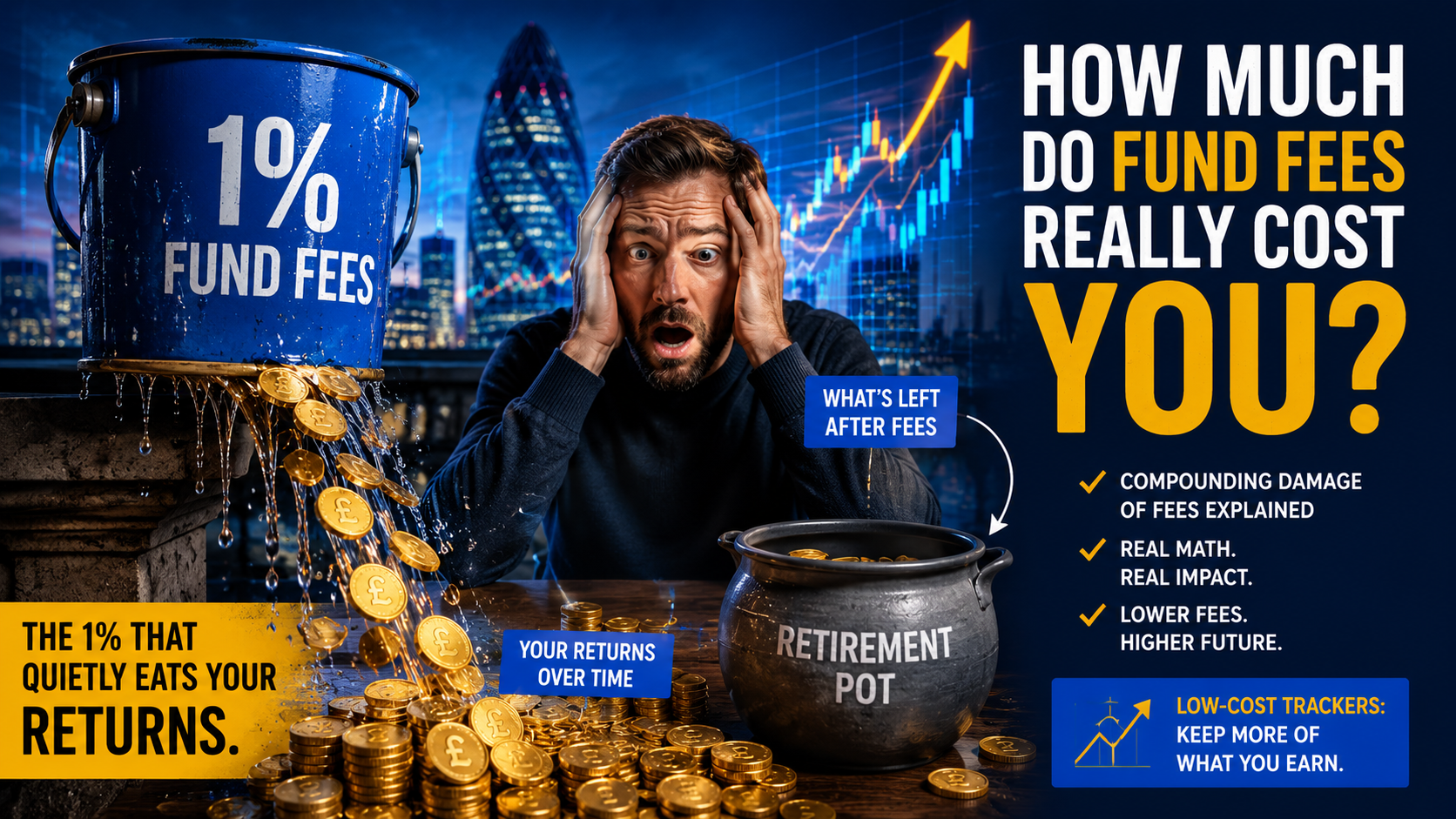
A seemingly harmless 1% annual fund charge can quietly remove tens of thousands of pounds from your portfolio over the long term. The effect is so powerful that many investment experts now argue that controlling costs is one of the few factors investors can genuinely control.
For UK investors building wealth through ISAs, pensions and general investment accounts, understanding how fees work could make a substantial difference to future financial outcomes.
Why Fees Matter More Than Most Investors Realise.
Investment fees are usually expressed as an annual percentage known as an ongoing charge or expense ratio. The fee is deducted from your investment automatically, meaning many investors never notice it.
The problem is that fees do not just reduce your returns in a single year. They reduce the amount of money available to compound in every future year as well.
This creates a compounding effect that works against investors.
Many actively managed funds still charge around 0.75% to 1.5% annually, while many tracker funds and ETFs can be purchased for between 0.07% and 0.25%. Morningstar data shows that most passive funds charge less than 0.5%, while active funds are commonly found in the 0.5% to 1.5% range.
At first glance, the difference may seem insignificant. Over decades, however, it becomes substantial.
The Maths Behind The 1% Fee.
Let's look at a simple example.
Imagine two investors each start with £50,000 and invest for 30 years.
Both achieve the same underlying market return of 7% per year before fees.
Investor A pays a low-cost fee of 0.2%.
Investor B pays a higher fee of 1.2%.
After fees, Investor A receives approximately 6.8% annually.
Investor B receives approximately 5.8% annually.
After 30 years:
- Investor A ends with approximately £359,000
- Investor B ends with approximately £271,000
The difference is around £88,000.
Nothing else changed.
Both investors experienced the same market performance.
The only difference was a 1% annual fee.
That £88,000 represents money that could have remained invested, continued compounding, and contributed toward retirement, financial independence or future family goals.
Why Compounding Works Against You When Fees Are High.
Albert Einstein is often credited with calling compound interest the eighth wonder of the world. Whether he actually said it or not, the principle remains true.
Compounding allows investors to earn returns on previous returns.
Unfortunately, fees compound as well.
Every pound removed in charges is a pound that can no longer generate future growth.
Over one year, the difference appears small.
Over thirty or forty years, the gap can become life-changing.
This is particularly important for younger investors who have decades ahead of them. A person investing from their twenties could potentially lose hundreds of thousands of pounds in future wealth simply by choosing unnecessarily expensive investment products.
The Active Versus Passive Debate.
Fund fees are often discussed alongside the active versus passive investing debate.
Active fund managers attempt to outperform the market through stock selection and market timing.
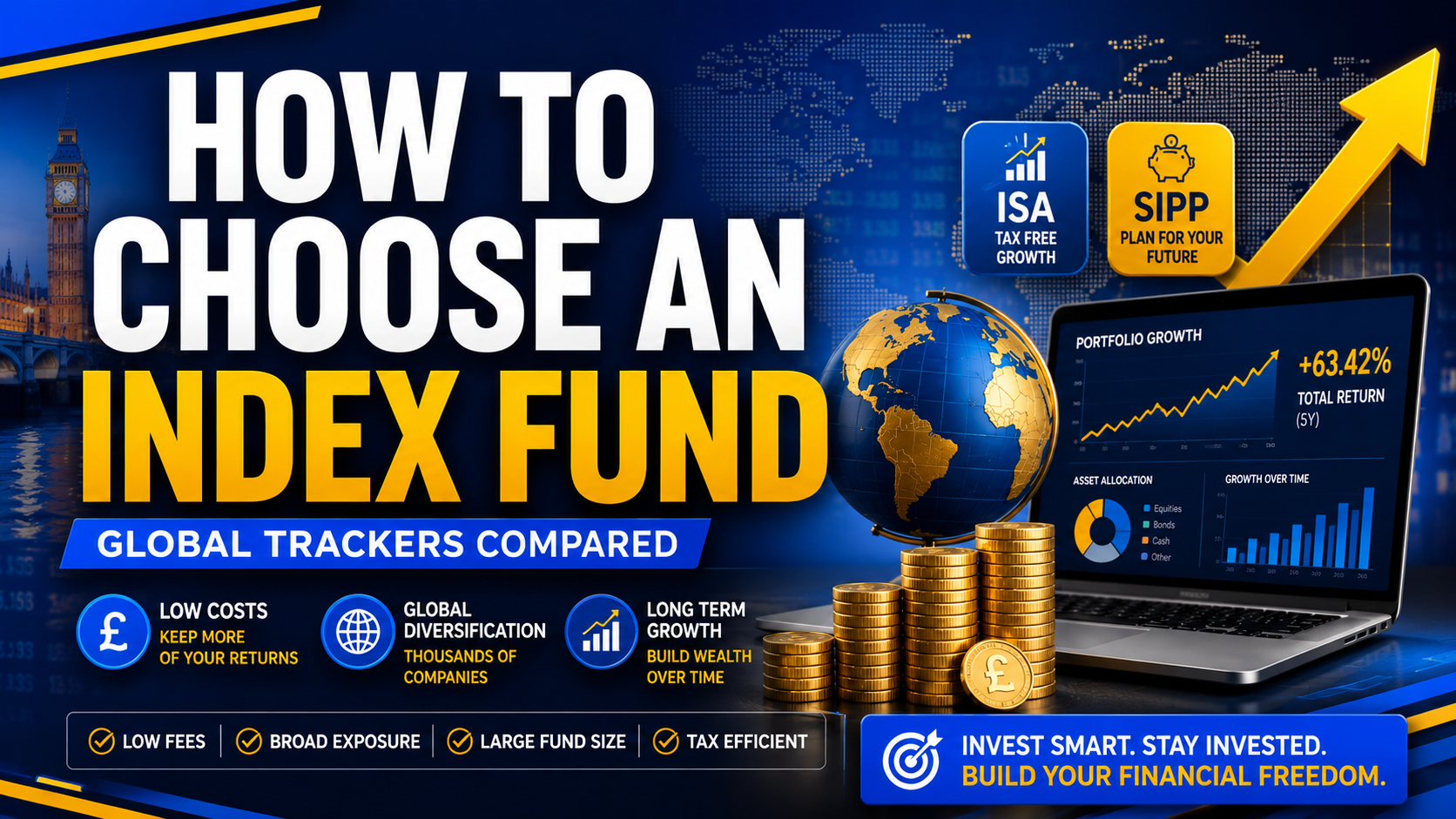
Passive funds, often called tracker funds or index funds, simply aim to match the performance of a market index such as the FTSE All-World Index or S&P 500.
The challenge for active managers is that they must outperform the market by enough to cover their higher fees.
Research consistently shows this is difficult.
AJ Bell analysis found that only around one-third of active funds outperformed passive alternatives over a ten-year period across key equity sectors. In some areas, the success rate was even lower.
This does not mean all active funds are bad investments.
Some managers do outperform.
The challenge is identifying those winners in advance rather than after the fact.
For many investors, low-cost trackers provide a simpler and more predictable route to capturing market returns.
UK Investors Are Voting With Their Money.
The shift towards passive investing has accelerated significantly in recent years.
According to Investment Association data highlighted by AJ Bell, tracker funds attracted a record £28 billion of retail inflows during 2024 while active funds experienced approximately £29 billion of outflows.
This trend reflects growing awareness of the impact that costs have on long-term returns.
Passive funds now represent around a quarter of invested assets in the UK, more than doubling their share over the past decade.
Investors increasingly recognise that lower fees provide an immediate and guaranteed benefit, whereas market outperformance remains uncertain.
The Hidden Cost Many Investors Never Calculate.
One reason high fees persist is that many investors never calculate their lifetime cost.
A fund charging 1% does not sound expensive.
However, consider someone with a £200,000 pension.
A 1% annual charge equals £2,000 per year.
Over twenty years, assuming growth and compounding, the actual cost can become dramatically larger than the simple annual figure suggests.
The investor is not just paying £2,000 per year.
They are also losing all future growth that money could have generated.
This is why experienced investors often focus heavily on costs when building portfolios.
Reducing fees is one of the few investing decisions that provides a guaranteed benefit from day one.
What Fees Should UK Investors Look For.
Fees are not limited to the fund's ongoing charge.
Investors should also consider:
- Platform fees
- Adviser fees
- Trading costs
- Transaction charges
- Performance fees
- Foreign exchange charges
A low-cost fund held on an expensive platform can still result in significant overall costs.
Before investing, it is worth reviewing the total cost of ownership rather than focusing solely on the headline fund charge.
Many leading global tracker funds now offer annual fees below 0.25%, while some major ETFs charge less than 0.10%.
When Paying Higher Fees Might Make Sense.
There are situations where paying more could be justified.
Some specialist funds operate in niche markets where passive alternatives are limited.
Certain investment strategies may require active management.
Professional financial advice can also provide value beyond investment selection, particularly for tax planning, retirement planning and behavioural coaching.
The key question is whether investors are receiving sufficient value for the additional cost.
Paying 1% more each year should ideally deliver benefits that outweigh the significant long-term drag on performance.
Unfortunately, many investors never ask that question.
Why Low-Cost Investing Continues To Gain Popularity.
The rise of passive investing is not solely about lower fees.
It is also about simplicity.
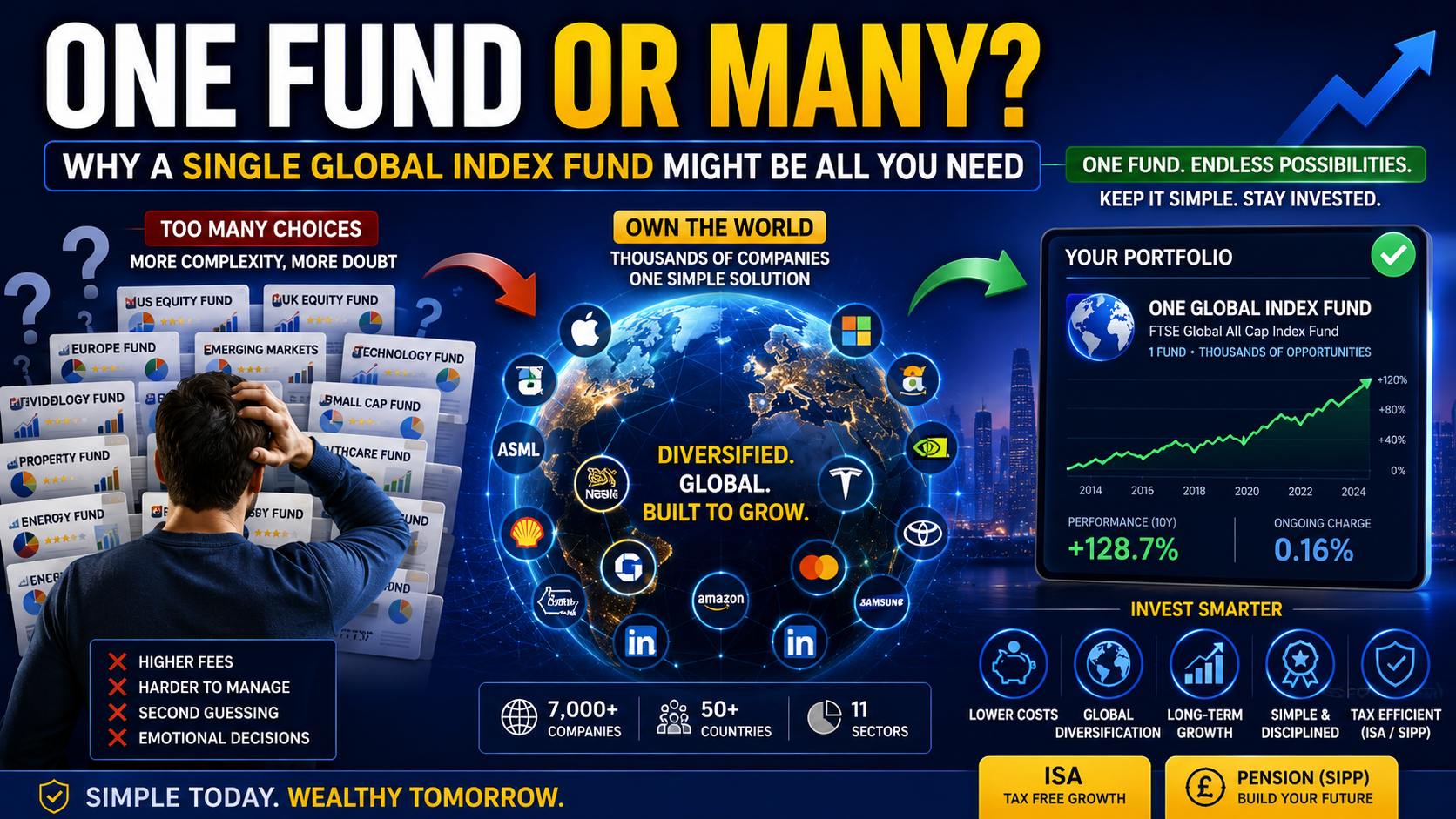
A globally diversified tracker fund can provide exposure to thousands of companies across multiple countries and sectors.
Instead of attempting to predict which manager or sector will outperform next year, investors can focus on saving consistently, staying invested and controlling costs.
The evidence suggests that this approach is proving increasingly attractive to UK savers.
As competition has increased, fund charges have continued falling, benefiting investors across the industry. Morningstar research notes that passive fund fees have declined significantly over time as providers compete for investor assets.
The Small Percentage That Can Change Everything.
Many investors spend countless hours researching investments that might outperform by 1% or 2%.
Far fewer spend time examining the fees quietly deducted from their portfolios every year.
Yet those charges can have a greater impact on long-term wealth than many market predictions ever will.
A 1% fee may appear insignificant today.
Over decades, it can become one of the largest financial decisions you make.
For investors building wealth through pensions, ISAs and long-term investment accounts, keeping costs low allows more of your money to remain invested and working on your behalf.
In investing, every percentage point matters.
And sometimes the most powerful return is the one you never have to give away.
Want to learn more about investing? Subscribe today and claim your free copy of the Investing for Beginners Handbook to start building your wealth with confidence.