Index funds have become one of the most popular ways for UK investors to build long-term wealth. From Stocks and Shares ISAs to pensions and self-invested personal pensions, millions of people now use low-cost tracker funds as the foundation of their investment strategy.
The appeal is easy to understand. Index funds are simple, affordable and diversified. Rather than trying to pick winning stocks, they aim to track the performance of a market index such as the FTSE 100, S&P 500 or FTSE Global All Cap.
However, one question continues to appear among new and experienced investors alike. Are index funds actually safe?
The answer is yes and no. Index funds are generally considered lower risk than trying to pick individual shares, but they are not risk-free. Understanding the risks of passive investing is essential if you want to invest with confidence and avoid nasty surprises during market downturns.
Why Index Funds Are Often Considered Safe.
Index funds spread your money across dozens, hundreds or even thousands of companies. Instead of relying on the success of one business, your returns are linked to the wider market.
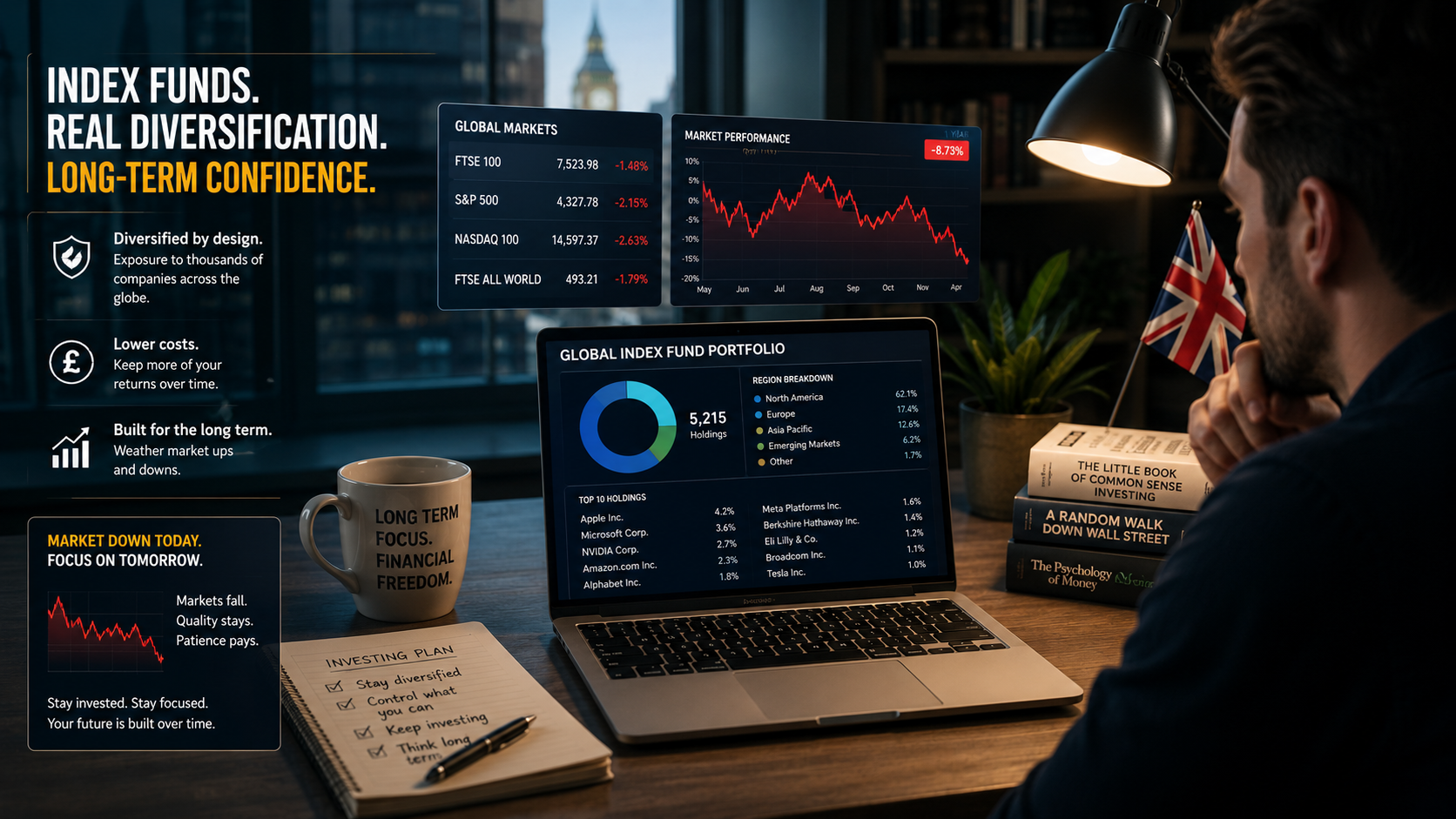
For example, a global index fund may hold shares in over 5,000 companies across developed and emerging markets. If one company performs poorly, the impact on your overall portfolio is usually limited.
This diversification is one of the biggest reasons passive investing has grown rapidly in the UK. According to data from the Investment Association, index-tracking strategies now account for around 35% of UK assets under management, up from 24% a decade ago.
For many investors, tracker funds offer a straightforward way to gain exposure to global markets without needing to research individual companies.
The Biggest Risk - Market Falls.
One of the most common misconceptions about index funds is that they somehow protect investors from stock market crashes.
They do not.
An index fund simply mirrors the market it tracks. If the market falls by 20%, your investment will typically fall by a similar amount.
History provides plenty of examples. During the global financial crisis of 2008, major stock market indices suffered significant losses. In early 2020, global markets plunged during the Covid-19 pandemic before eventually recovering.
More recently, rising interest rates and inflation created difficult conditions for both shares and bonds during 2022.
The important distinction is that index funds reduce company-specific risk, but they cannot eliminate market risk.
Investors who panic and sell during market downturns often lock in losses. Those who remain invested have historically benefited from eventual recoveries, although future returns are never guaranteed.
Concentration Risk Is Bigger Than Many People Realise.
Many investors assume that owning a global index fund means their money is evenly spread across thousands of companies.
In reality, most market-cap weighted index funds allocate more money to the largest companies.
This means a relatively small number of businesses can have an outsized influence on performance.
Today, some of the world's largest technology companies represent a significant proportion of major global indices. If those companies struggle, the impact can ripple through many passive portfolios.
For example, investors in a global tracker may be surprised to learn that a substantial percentage of their money is invested in US equities, with large technology firms dominating the top holdings.
This is not necessarily a problem, but it highlights an important truth. Diversification does not always mean equal diversification.
Understanding what your chosen index actually holds is just as important as understanding the fund itself.
Index Funds Cannot Protect Against Economic Recessions.
Another misconception is that passive investing somehow shields investors from economic downturns.
While diversification can help reduce risk, index funds remain exposed to broader economic conditions.
Recessions can lead to falling corporate earnings, reduced consumer spending and lower investor confidence. These factors often result in declining share prices across entire markets.
Even the most diversified global tracker fund cannot avoid these pressures completely.
What it can do is provide exposure across different countries, sectors and industries, which may help reduce the impact of weakness in any one area.
This is why many financial planners encourage investors to focus on long-term goals rather than short-term economic headlines.
What Index Funds Do Protect Against.
Although index funds cannot prevent losses during market declines, they do offer protection against several common investing mistakes.
Firstly, they remove stock-picking risk. Many individual investors struggle to consistently identify winning companies.
Secondly, they reduce manager risk. Active funds rely on fund managers making the right decisions. If those decisions prove wrong, performance can suffer.
Thirdly, they typically offer lower fees. Over time, lower costs can have a meaningful impact on long-term returns.
Research consistently shows that many active fund managers struggle to outperform their benchmark indices over extended periods after fees are taken into account.
This has been one of the key drivers behind the continued growth of passive investing globally.
The Risk of Following the Crowd.
Some critics argue that the growing popularity of passive investing creates new risks.
As more money flows into tracker funds, larger companies receive more investment simply because they already occupy larger positions in an index.
This has led to concerns that passive investing may contribute to higher valuations in certain areas of the market.
While researchers continue to debate the long-term implications, there is currently little evidence that passive investing alone is creating widespread market instability.
Even so, it serves as a reminder that no investment strategy is perfect.
Investing success is rarely about finding a flawless solution. It is usually about choosing the most appropriate solution for your goals and risk tolerance.
How Safe Are UK Index Fund Providers?
Some investors worry about what happens if a provider such as Vanguard, HSBC, iShares or Fidelity experiences financial difficulties.
In most cases, the underlying assets within a fund are held separately from the provider's own finances.
This means your investments remain legally distinct from the company operating the fund.
UK investors also benefit from regulation provided by the Financial Conduct Authority, which oversees authorised investment firms and products.
While operational risks can never be completely eliminated, the structure of regulated funds provides an additional layer of protection.
What UK Investors Should Know About Passive Investing Today.
Passive investing is no longer a niche strategy. It has become a mainstream approach used by millions of investors.
Recent industry figures show UK index-tracking strategies have reached their highest-ever share of assets under management at around 35% of the market.
Meanwhile, HMRC data shows total ISA subscriptions reached approximately £103 billion across 15 million adult ISA accounts during the 2023-24 tax year, highlighting the growing popularity of tax-efficient investing among UK savers.
These figures suggest more people are embracing long-term investing, often using index funds as their preferred investment vehicle.
However, popularity should never be confused with certainty.
Markets will continue to rise and fall. Economic conditions will change. Some years will be excellent and others will be disappointing.
The key is understanding what you own and why you own it.
Building Confidence Without Ignoring Risk.
Perhaps the most important lesson for investors is that safety does not mean the absence of risk.
Index funds are safer than many alternatives because they offer diversification, low costs and broad market exposure. Yet they still carry investment risk and can experience significant short-term losses.
For investors with long time horizons, those risks have historically been rewarded with opportunities for growth that cash savings alone often struggle to match.
The goal is not to avoid risk entirely. The goal is to take sensible, manageable risks that align with your financial objectives.
When viewed through that lens, index funds remain one of the most accessible and practical tools available for building long-term wealth, provided investors understand both their strengths and their limitations.
Want to learn more? Subscribe and claim your free copy of the Investing for Beginners Handbook eBook to start building your investment knowledge today.