For many people, investing can feel intimidating. News headlines constantly warn about market crashes, recessions, inflation and economic uncertainty. It is no surprise that many beginners hesitate to invest because they worry about buying at the wrong time.
Pound-cost averaging is a simple investing strategy designed to remove much of that stress. Instead of trying to predict when markets will rise or fall, investors commit to investing a fixed amount of money at regular intervals, usually monthly.
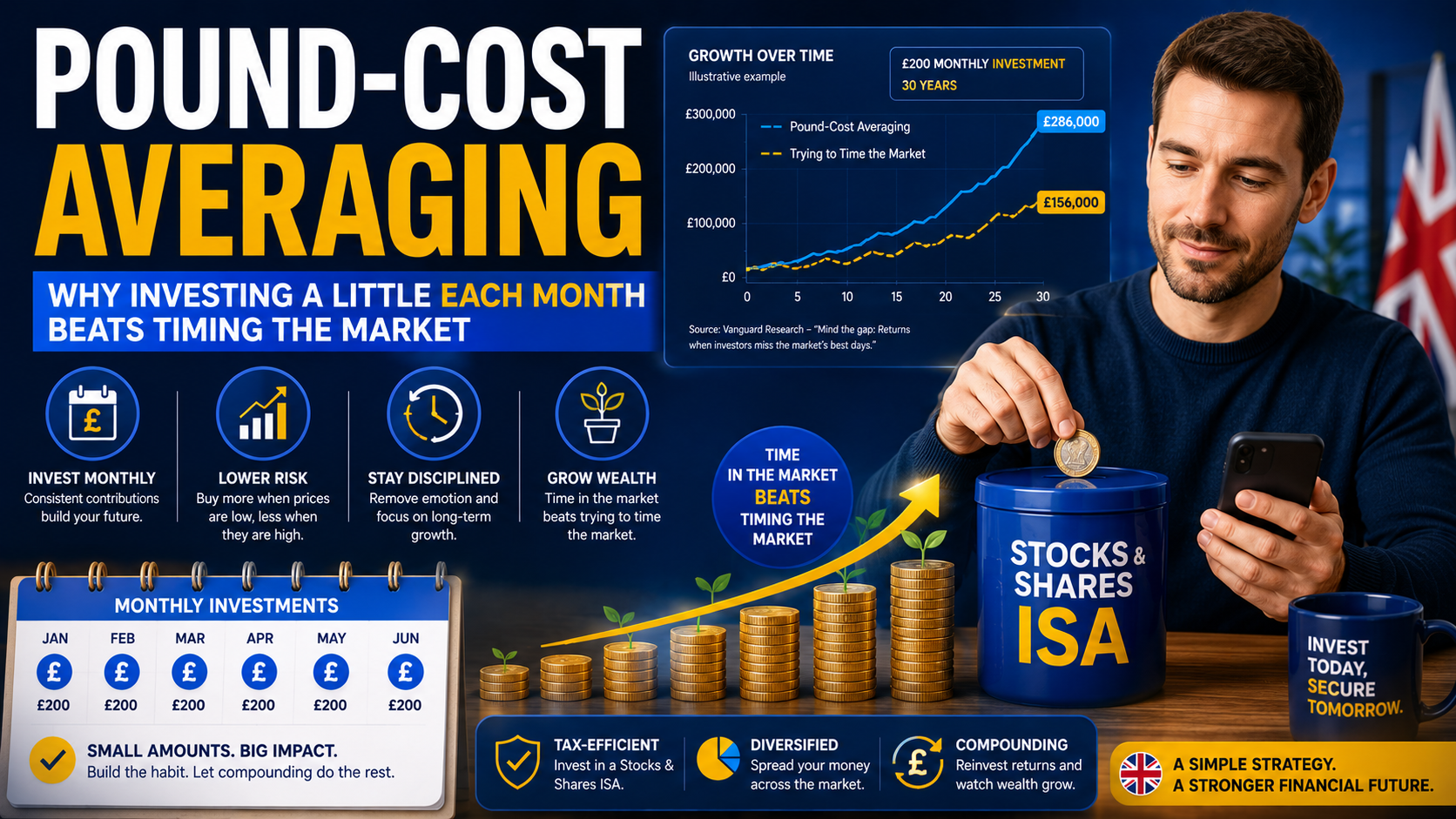
For example, rather than investing £12,000 all at once, an investor could choose to invest £1,000 each month over the course of a year. When prices are high, that fixed amount buys fewer shares. When prices are lower, it buys more shares. Over time, this creates an average purchase price across different market conditions.
The strategy is popular among beginners because it focuses on consistency rather than prediction.
Why Timing The Market Is So Difficult.
Many new investors believe successful investing is about buying at the lowest point and selling at the highest point. While that sounds logical, the reality is very different.
Even professional fund managers struggle to consistently predict short-term market movements. Markets react to interest rates, economic data, geopolitical events, company earnings and investor sentiment. These factors can change rapidly and unexpectedly.
Research repeatedly shows that missing just a handful of the stock market's strongest days can dramatically reduce long-term returns. Investors who move in and out of markets often end up buying after prices have risen and selling after prices have fallen, which is the opposite of what creates wealth.
Pound-cost averaging helps eliminate emotional decision-making. Instead of worrying about whether now is the perfect time to invest, investors continue contributing regardless of market conditions.
How Pound-Cost Averaging Works In Practice.
Imagine two investors each have £12,000 to invest.
The first investor waits for what they believe is the perfect market opportunity. They spend months watching market news and attempting to identify the ideal entry point.
The second investor contributes £1,000 every month into a diversified index fund.
During the year, markets rise, fall and fluctuate. The second investor automatically buys more units when prices decline and fewer when prices rise. Their average purchase price reflects a range of market conditions rather than a single moment in time.
This process can help reduce the impact of short-term volatility and makes investing feel far more manageable for nervous beginners.
Many workplace pensions, Stocks and Shares ISAs and investment platforms allow automatic monthly contributions, making the strategy easy to implement.
Why Monthly Investing Appeals To Beginners.
One of the biggest barriers to investing is fear.
Many people worry about investing just before a market correction. Others fear losing money immediately after investing a lump sum. These concerns often result in endless delays.
Monthly investing helps overcome these psychological hurdles because investors commit smaller amounts over time rather than placing a large sum into the market all at once.
The UK's Financial Conduct Authority has found that many adults still hold substantial amounts of their long-term savings in cash despite inflation reducing purchasing power. Research also suggests many people remain cautious about investing due to concerns about market risk.
By investing regularly, beginners gain exposure to the market gradually while building confidence and experience along the way.
The Cost Of Staying In Cash.
While holding cash feels safe, it can carry its own risks.
Inflation gradually reduces purchasing power over time. If inflation rises faster than the interest earned on savings accounts, money effectively loses value in real terms.
Recent analysis suggests UK households continue to hold large amounts of wealth in cash savings. Barclays estimates that approximately £610 billion could potentially be invested rather than sitting in cash accounts.
Research has also shown that nearly £325 billion sits in UK current accounts earning no interest at all.
While cash remains essential for emergency funds and short-term goals, long-term investors may benefit from putting a portion of their money to work through diversified investments.
The UK Investing Gap.
The UK has historically been a nation of savers rather than investors.
According to investment industry data, only a minority of UK adults actively invest in the stock market, despite widespread use of savings products.
At the same time, ISA accounts remain extremely popular. Millions of adults use ISAs to save and invest tax efficiently, with total ISA assets reaching hundreds of billions of pounds.
For beginners, a Stocks and Shares ISA often provides one of the simplest ways to begin investing regularly. Contributions can be automated, investments grow free from capital gains tax, and any dividends received are sheltered from additional tax within the ISA wrapper.
These advantages make pound-cost averaging particularly attractive for long-term wealth building.
Market Volatility Can Become An Opportunity.
Most people view falling markets as bad news.
However, for investors who contribute monthly, market declines can actually create opportunities.
When prices fall, the same monthly contribution buys more shares or fund units. If markets recover over time, those additional units may contribute significantly to future growth.
This concept can feel counterintuitive because negative headlines often encourage people to stop investing. Yet historically, market downturns have often been followed by recoveries.
Regular investing encourages discipline during these periods and prevents emotional decisions that can harm long-term returns.
The Power Of Compounding.
Pound-cost averaging becomes even more effective when combined with compounding.
Compounding occurs when investment returns generate additional returns over time. In simple terms, your money starts earning money on previous gains.
A monthly investment of even modest amounts can grow substantially over long periods.
For example, someone investing £200 per month for 30 years could potentially accumulate a significant portfolio, depending on investment performance and market conditions.
The earlier an investor starts, the more time compounding has to work.
This is why many financial planners encourage people to begin investing as soon as possible rather than waiting for the perfect moment.
Common Mistakes To Avoid.
Although pound-cost averaging is straightforward, there are still mistakes investors should avoid.
One common mistake is constantly checking portfolio values and reacting emotionally to short-term fluctuations. Investing is generally most effective when viewed through a long-term lens.
Another mistake is stopping contributions during market downturns. Some of the best buying opportunities can occur during periods of uncertainty.
Investors should also ensure they maintain an emergency fund before investing. Money needed within the next few years is usually better kept in cash rather than exposed to market volatility.
Finally, diversification remains important. Investing in broad index funds rather than a handful of individual shares can help spread risk across many companies and sectors.
Why Consistency Usually Wins.
Successful investing is often less about intelligence and more about behaviour.
The investors who build wealth over decades are usually not the ones making bold predictions. Instead, they are the people who contribute consistently, remain patient and stay invested through market cycles.
Pound-cost averaging provides a framework for doing exactly that.
Rather than worrying about whether markets will rise next week or next month, investors focus on a habit they can control. Over time, that habit can become one of the most powerful wealth-building tools available.
For beginners especially, regular monthly investing offers a practical way to start building financial confidence while avoiding the pressure of trying to time the market perfectly.
Want to learn more? Subscribe today and claim your free copy of the Investing for Beginners Handbook eBook.
Keep reading: How to Start Investing in the UK: A Beginner's Step-by-Step Guide.