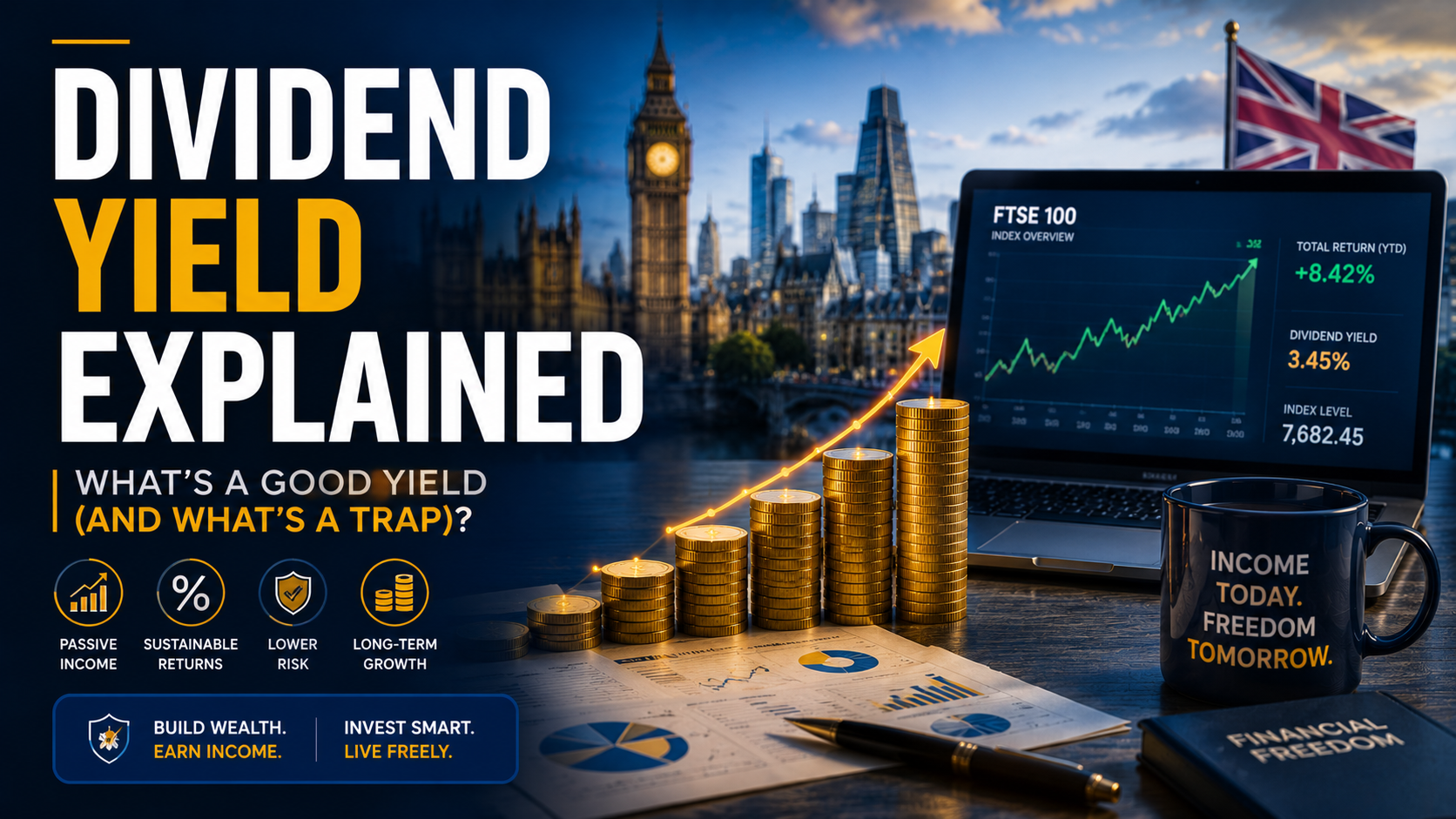
For many new investors, few questions come up more often than whether dividend investing or index funds are the better route to passive income. Both strategies have loyal supporters, both have produced strong long-term results, and both can play an important role in building wealth.
The challenge is that they serve slightly different purposes.
Dividend investing focuses on generating regular income from companies that distribute a portion of their profits to shareholders. Index funds, on the other hand, aim to track the performance of a market index and typically prioritise overall returns through a combination of capital growth and dividends.
If your goal is to create passive income while growing your wealth over time, understanding the strengths and weaknesses of each approach can help you make a more informed decision.
What Is Dividend Investing?
Dividend investing involves buying shares in companies that pay regular dividends. These payments are typically made quarterly, semi-annually, or annually and represent a share of the company's profits.
Many dividend investors favour established businesses with strong cash flows, stable earnings, and long histories of rewarding shareholders. Examples often include companies in sectors such as utilities, consumer goods, banking, telecommunications, and energy.
The main attraction is obvious. Investors receive cash payments without needing to sell their shares.
For someone aiming to supplement their income, build a retirement portfolio, or eventually live from their investments, dividends can provide a predictable source of cash flow.
In the UK, many investors use a Stocks and Shares ISA to hold dividend-paying investments, allowing dividend income and capital gains to grow free from tax within the ISA wrapper. More than 4 million people contributed to a Stocks and Shares ISA during the 2023/24 tax year, highlighting the growing popularity of investing among UK savers.
What Are Index Funds?
Index funds are designed to track the performance of a specific stock market index, such as the FTSE 100, FTSE All-World, or S&P 500.
Instead of trying to pick winning companies, an index fund simply owns all or most of the companies within its chosen index. This approach provides instant diversification and typically comes with very low fees.
The growth of passive investing has been one of the biggest trends in modern investing. According to industry data, passive strategies now account for more than a third of investment funds in the UK market, with demand continuing to rise as investors seek low-cost solutions.
For beginners, index funds offer a simple way to gain exposure to hundreds or even thousands of companies through a single investment.
Why Dividend Investors Love the Strategy.
One reason dividend investing remains popular is psychological.
Receiving regular income feels tangible. Instead of relying entirely on market growth, investors can see money arriving in their account throughout the year.
Dividend investing also encourages a focus on quality businesses. Companies that consistently increase dividends often have strong balance sheets, resilient earnings, and disciplined management teams.
Another advantage is flexibility. Investors can choose to spend the dividends as income or reinvest them to accelerate portfolio growth through compounding.
Over time, reinvested dividends can contribute significantly to total returns. In fact, numerous long-term market studies have shown that dividends account for a substantial portion of total stock market returns over several decades.
For investors approaching retirement, dividend-focused portfolios may also reduce the need to sell assets during market downturns.
Why Index Fund Investors Prefer Simplicity.
The strongest argument for index funds is simplicity.
Rather than researching individual companies, monitoring dividend sustainability, or analysing earnings reports, investors can buy a broad market fund and let it work in the background.
Index funds also provide diversification that would be difficult and expensive for most individuals to replicate on their own.
A single global index fund may contain thousands of companies across multiple countries and industries. If one business struggles, its impact on the overall portfolio is relatively small.
Costs are another major advantage. Passive funds generally charge lower fees than actively managed funds because they simply track an index rather than employing teams of analysts to select investments. The Financial Conduct Authority has noted that lower costs are one of the key benefits driving the rise of passive investing.
For many investors, lower fees can translate into higher long-term returns.
Comparing Passive Income Potential.
When most people hear "passive income", they immediately think of dividends.
However, passive income does not always have to come directly from dividend payments.
Dividend investors receive cash distributions automatically. Depending on the portfolio, yields may range from around 3% to 6% annually, although yields vary significantly between sectors and market conditions.
Index funds also pay dividends because the underlying companies distribute profits. The difference is that many broad market funds have lower yields, often because they contain growth-focused companies that reinvest profits instead of paying them out.
The trade-off is that those growth companies may generate stronger capital appreciation over time.
An investor seeking maximum current income may therefore lean towards dividend investing, while an investor focused on long-term wealth creation may favour broad index funds.
The Growth Question.
This is where the debate becomes more interesting.
Historically, broad stock market indexes have often outperformed many dividend-focused portfolios over long periods because they include both income-producing companies and high-growth businesses.
Technology giants, for example, have been among the biggest drivers of global stock market returns over the past decade despite often paying relatively small dividends.
Investors who concentrated solely on high-yield shares may have missed some of that growth.
At the same time, dividend-focused companies can offer greater stability during volatile periods. Their established business models and cash generation often help cushion declines during economic uncertainty.
The reality is that neither strategy wins in every market environment.
Risk Considerations Investors Should Understand.
No investment strategy is risk-free.
Dividend investors face the risk of dividend cuts. A high yield may look attractive, but if a company experiences financial difficulties, management can reduce or suspend dividend payments.
The COVID-19 pandemic demonstrated this clearly, with many companies temporarily reducing shareholder distributions.
Index fund investors face a different challenge. Because they own the entire market, they cannot avoid market downturns.
When global markets decline, index funds decline as well.
However, broad diversification reduces company-specific risk and helps protect against catastrophic losses from a single investment mistake.
For beginners, avoiding major mistakes is often more important than finding the perfect investment.
What Do UK Investors Tend to Choose?
Recent industry data suggests passive investing continues to gain momentum across the UK.
Investment Association figures show growing demand for tracker funds and low-cost investment products. Passive strategies have become increasingly popular among retail investors seeking long-term growth with minimal maintenance.
Research also indicates that seven of the ten most popular funds purchased by UK DIY investors in 2025 were passive investments.
That does not mean dividend investing is disappearing. Income-focused investment trusts, dividend ETFs, and dividend stock portfolios remain popular, particularly among retirees and investors approaching financial independence.
The growing popularity of Stocks and Shares ISAs has also created opportunities for both approaches to be held tax efficiently. The UK ISA market continues to expand, with millions of investors using ISAs to shelter investment gains from tax.
Can You Combine Both Strategies?
Absolutely.
In fact, many experienced investors do exactly that.
A common approach is to use a global index fund as the foundation of a portfolio and then add a dividend-focused fund or a selection of dividend-paying shares around the edges.
This creates a balance between growth and income.
The index fund provides broad diversification and exposure to global market growth, while dividend investments generate a stream of cash flow that can either be reinvested or spent.
For many investors, this hybrid approach removes the pressure of choosing one side in the debate.
Which Option Is Better for Passive Income?
The answer depends largely on your objective.
If your priority is generating income today, dividend investing often has the edge. The regular cash payments provide a clear and visible source of passive income.
If your goal is maximising long-term wealth with minimal effort, index funds are difficult to beat. Their diversification, low costs, and simplicity have helped millions of investors build substantial portfolios over time.
For beginners, index funds are often the easiest place to start. They reduce complexity and remove much of the guesswork involved in selecting individual companies.
Dividend investing can then become a useful addition as your knowledge, confidence, and income requirements evolve.
Rather than asking which strategy is universally better, a more useful question is which strategy best matches your financial goals, risk tolerance, and investment timeline. The most successful investors are often those who remain consistent, keep costs low, and stay invested for the long term regardless of which approach they choose.
Want to start investing with confidence? Subscribe today and get a free copy of our eBook, Investing for Beginners Handbook.