Cryptocurrency has become a mainstream investment topic in the UK, attracting everyone from experienced investors to complete beginners. While digital assets offer opportunities, they have also created fertile ground for fraudsters looking to exploit excitement, fear of missing out, and a lack of understanding about how crypto markets work.
The scale of the problem is significant. According to City of London Police and Action Fraud data, UK victims lost more than £649 million to investment fraud during 2024, with cryptocurrency-related scams accounting for 66% of all investment fraud reports. More than 17,000 crypto investment fraud reports were submitted during the year alone.
As cryptocurrency adoption continues to grow, scammers are becoming more sophisticated. Understanding how these schemes operate is one of the most effective ways to protect yourself and your money.
Why Crypto Scams Continue to Rise.
Unlike traditional banking systems, cryptocurrency transactions are typically irreversible. Once funds have been sent to a scammer's wallet, recovering them can be extremely difficult.
Fraudsters also benefit from the speed of social media, messaging apps and online advertising. Action Fraud data has shown that social media platforms and messaging services frequently appear in investment fraud reports, giving criminals access to millions of potential victims.
The combination of hype, anonymity and rapidly evolving technology has created an environment where scams can spread quickly before regulators or platforms are able to intervene.
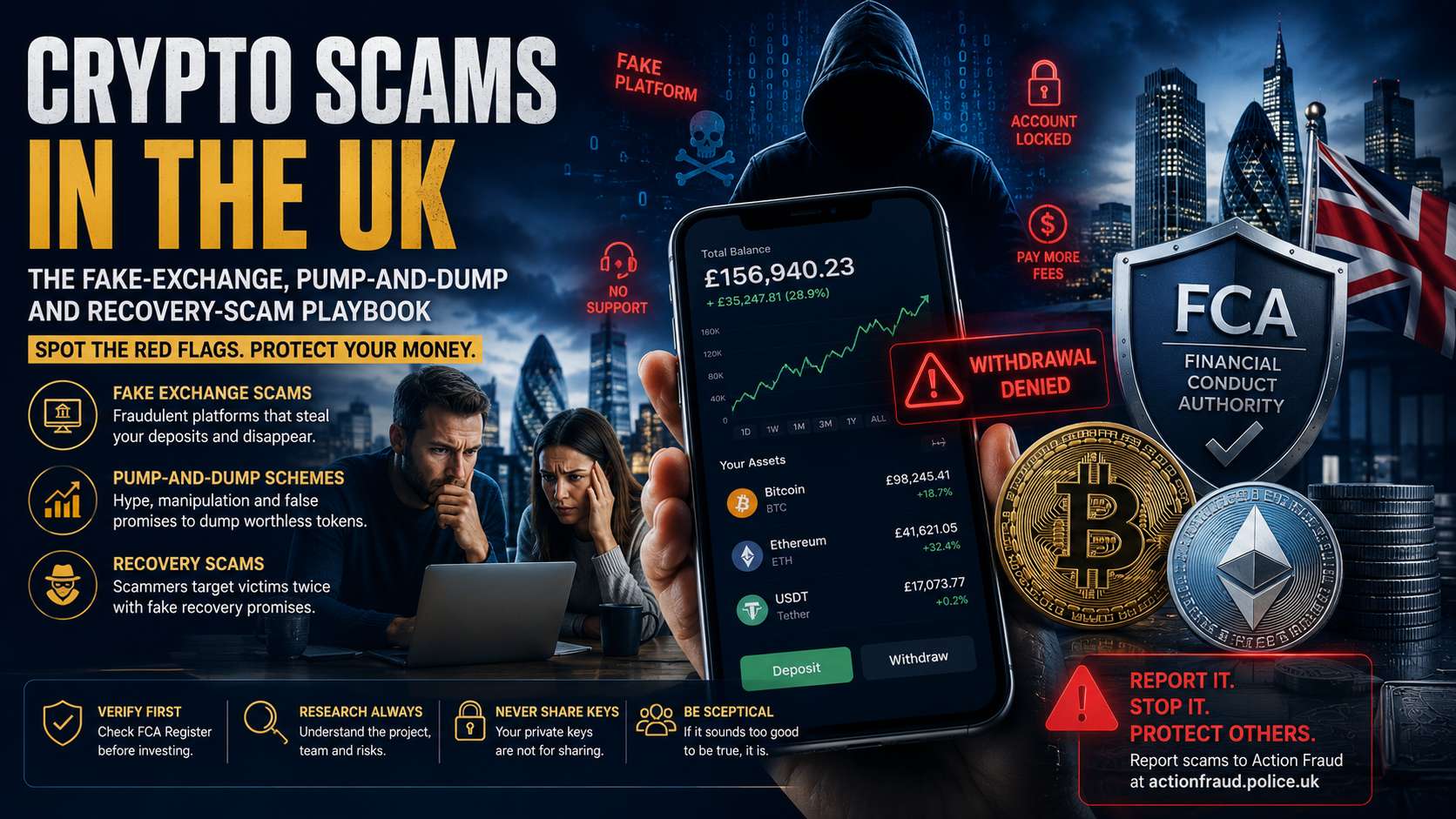
The Fake Exchange Scam Playbook.
One of the most common crypto scams involves fake cryptocurrency exchanges that are designed to look legitimate.
At first glance, these websites often appear professional. They may display live market prices, customer testimonials, fake regulatory logos and even fabricated account balances showing impressive profits.
The scam usually begins through social media, dating apps, WhatsApp messages, Telegram groups or online advertisements. Victims are encouraged to create an account and deposit funds to start investing.
Initially, everything appears normal. Investors may even see impressive gains displayed on their dashboard. Some platforms allow a small withdrawal early on to build trust.
The problems begin when the investor attempts to withdraw larger amounts. Suddenly there are unexpected taxes, account verification fees, security charges or withdrawal processing costs. Every payment leads to another demand for money.
Eventually the platform disappears completely, customer support stops responding, and the investor discovers the exchange was never legitimate.
Red Flags of Fake Crypto Exchanges.
A fake exchange often reveals itself through several warning signs:
- No registration with the Financial Conduct Authority (FCA).
- Guaranteed returns or risk-free profits.
- Pressure to deposit quickly.
- Withdrawal restrictions or unexpected fees.
- Unsolicited contact through social media or messaging apps.
- Poor online reviews or recently created websites.
- Fake celebrity endorsements.
Before depositing any money, investors should always verify firms using the FCA Register and the FCA Warning List.
The Pump-and-Dump Scam Playbook.
Pump-and-dump schemes have existed in financial markets for decades, but cryptocurrency has given fraudsters a new playground.
The process typically starts with scammers buying a low-value cryptocurrency token before promoting it aggressively online. They may use social media influencers, private Telegram groups, Discord channels, YouTube videos or coordinated posts across multiple platforms.
The goal is simple. Create excitement and convince investors that a particular coin is about to experience explosive growth.
As more people buy the asset, demand pushes the price higher. This creates a fear of missing out among retail investors who rush to join the rally.
Once the price reaches a certain level, the organisers sell their holdings. The sudden wave of selling causes the token's value to collapse, leaving late investors with substantial losses.
In many cases, the token has little real utility and no long-term value beyond the hype created by its promoters.
Red Flags of Pump-and-Dump Schemes.
Investors should be cautious when they see:
- Claims that a coin will "100x" or "guarantee profits".
- Coordinated buying campaigns.
- Sudden spikes in social media activity.
- Anonymous project teams.
- Little information about the project's purpose.
- Influencers promoting obscure coins without proper disclosure.
- Pressure to buy immediately before a supposed price surge.
Legitimate investments rarely require urgent action. If someone insists that you must buy within hours or miss the opportunity forever, caution is usually justified.
The Recovery Scam Playbook.
Recovery scams target people who have already lost money to fraud.
These schemes are particularly cruel because they exploit victims when they are vulnerable and desperate to recover their losses.
A fraudster contacts the victim claiming to be from a recovery company, law firm, regulator, government agency or blockchain investigation service.
They often possess detailed information about the original scam because victim lists are frequently sold among criminal networks.
The scammer promises to trace lost funds, freeze stolen cryptocurrency or recover assets through legal action.
However, before any recovery can take place, the victim is asked to pay upfront fees, taxes, administration costs or legal charges.
Once payment is made, the scammer disappears or continues requesting additional payments.
The reality is that no legitimate organisation can guarantee the recovery of stolen cryptocurrency.
Red Flags of Recovery Scams.
Warning signs include:
- Unsolicited contact about lost investments.
- Guarantees that funds can be recovered.
- Requests for upfront payments.
- Claims of special relationships with regulators or law enforcement.
- Pressure to act immediately.
- Requests for wallet access or private keys.
Anyone claiming they can instantly recover stolen crypto should be treated with extreme caution.
Celebrity Endorsement and Deepfake Scams.
Advances in artificial intelligence have created a new generation of cryptocurrency scams.
Fraudsters increasingly use deepfake videos and manipulated images to impersonate celebrities, financial experts and well-known business leaders.
These videos often appear highly convincing and may promote fake investment opportunities, crypto giveaways or exclusive trading platforms.
Some scammers have even impersonated trusted consumer figures and public personalities to encourage people to transfer funds.
The technology continues to improve, making it more important than ever to verify information through official sources rather than relying on videos shared online.
The UK Statistics Investors Should Know.
Several recent figures help illustrate the scale of crypto fraud across the UK:
- More than £649 million was lost to investment fraud in 2024.
- Cryptocurrency represented 66% of all investment fraud reports.
- More than 17,000 crypto investment fraud reports were made during 2024.
- People aged 35 to 44 were among the most frequently targeted groups.
- Individuals aged 55 to 64 suffered some of the highest financial losses.
- UK Finance reported £1.17 billion in total fraud losses across the UK financial system.
- Research from Cifas and the Global Anti-Scam Alliance estimated that UK consumers lost approximately £11.4 billion to scams over a 12-month period.
These figures demonstrate that cryptocurrency fraud is not a niche problem. It affects thousands of people every year across every age group and income level.
How to Protect Yourself from Crypto Scams.
The good news is that many crypto scams share similar characteristics, making them easier to identify when you know what to look for.
Always research any investment thoroughly before committing funds. Verify that firms are authorised where appropriate and check independent reviews from multiple sources.
Be sceptical of guaranteed returns. Every legitimate investment carries some level of risk.
Avoid acting under pressure. Scammers frequently create false urgency to stop victims from thinking clearly.
Never share private wallet keys, seed phrases or account credentials.
Enable two-factor authentication on all crypto-related accounts.
If you are approached unexpectedly about an investment opportunity, assume it could be fraudulent until proven otherwise.
Finally, remember that if an opportunity sounds too good to be true, it usually is.
Staying One Step Ahead of Fraudsters.
Cryptocurrency technology continues to evolve, and unfortunately so do the tactics used by criminals. Fake exchanges, pump-and-dump schemes and recovery scams remain among the most common threats facing UK investors today.
The most effective defence is education. Understanding how these scams operate, recognising their warning signs and taking time to verify opportunities can significantly reduce the risk of becoming a victim.
Successful investing is rarely about chasing quick profits. It is about making informed decisions, managing risk carefully and staying focused on long-term financial goals.
Want to build your investing knowledge from the ground up? Subscribe today and claim your free copy of the Investing for Beginners Handbook eBook.
Keep reading: What Are Alternative Assets? A Beginner's Guide for UK Investors, How Is Cryptocurrency Taxed in the UK? Capital Gains, Income and Reporting, Stocks and Shares ISA Explained in Plain English (2026/27): A Beginner's Guide to Tax-Free Investing and Should You Hold Bitcoin in Your Portfolio? The Case For and Against.