Bitcoin has gone from a niche digital experiment to a mainstream investment discussed by financial advisers, wealth managers and everyday investors alike. With Bitcoin regularly making headlines during both market rallies and sharp declines, many people are asking the same question: should Bitcoin have a place in a long-term investment portfolio?
The answer is not as straightforward as enthusiasts or critics often suggest. Bitcoin has delivered extraordinary returns over the past decade, but it has also experienced dramatic price swings that would make many traditional investors uncomfortable. Rather than viewing Bitcoin as either a guaranteed path to wealth or a speculative gamble to avoid entirely, investors may benefit from understanding both sides of the debate.
Bitcoin's Growing Role in UK Investment Portfolios.
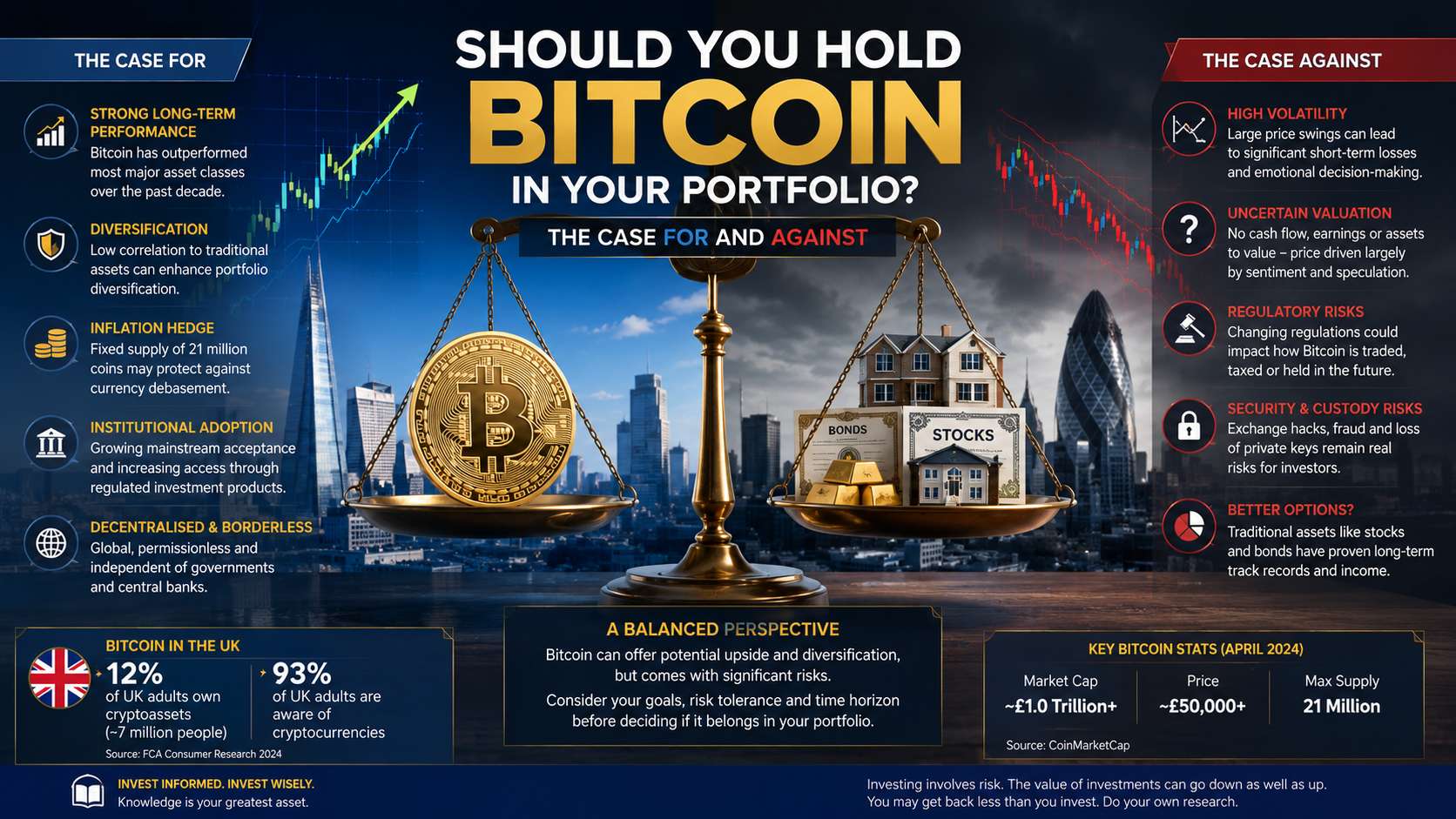
Bitcoin ownership has become increasingly common in the UK. Research published by the Financial Conduct Authority (FCA) found that 12% of UK adults owned crypto assets in 2024, equivalent to around seven million people. The same research found that awareness of cryptocurrencies had risen to 93% of UK adults.
Bitcoin remains the most recognised and widely held cryptocurrency among UK investors. As institutional adoption has increased globally through exchange-traded products, corporate treasury holdings and pension fund discussions, Bitcoin has gradually moved closer to the financial mainstream.
However, popularity alone does not determine whether an investment deserves a place in a diversified portfolio. Investors still need to assess the potential advantages and drawbacks.
The Case For Holding Bitcoin.
Supporters of Bitcoin often point to its unique characteristics and long-term performance record as reasons to consider allocating a small portion of a portfolio to the asset.
One of the strongest arguments is historical performance. Despite significant volatility, Bitcoin has delivered returns that have far exceeded most traditional asset classes over longer periods. While past performance never guarantees future results, investors who held Bitcoin through multiple market cycles have generally been rewarded for their patience.
Another commonly cited benefit is diversification. Bitcoin operates independently from central banks and governments. While correlations with traditional assets can increase during periods of market stress, Bitcoin often behaves differently from shares, bonds and property over longer periods. This means a modest allocation could potentially improve overall portfolio diversification.
Supporters also view Bitcoin as a hedge against currency debasement. Unlike traditional currencies, Bitcoin has a fixed supply cap of 21 million coins. This scarcity is one reason many investors compare it to digital gold. As governments around the world continue to increase debt levels and central banks expand money supplies, some investors see Bitcoin as protection against long-term inflationary pressures.
Institutional adoption has strengthened the investment case as well. Large financial institutions that once dismissed Bitcoin are now offering crypto-related products and services. The approval of spot Bitcoin exchange-traded funds in major markets has also made access easier for both retail and professional investors.
The Case Against Holding Bitcoin.
While Bitcoin's growth story is compelling, there are legitimate reasons why many investors choose to avoid it altogether.
Volatility remains the biggest concern. Bitcoin's price movements can be dramatic even by stock market standards. Research from BlackRock's iShares platform found Bitcoin's volatility remains several times higher than global equities, despite declining over time.
For example, Bitcoin has experienced multiple drawdowns exceeding 50% throughout its history. Investors who cannot tolerate significant fluctuations may find it difficult to remain invested during market downturns.
Another challenge is valuation. Unlike a company share, Bitcoin does not generate earnings, dividends or cash flow. Traditional valuation methods that investors use for stocks or bonds do not apply. This makes it difficult to determine what Bitcoin is truly worth, leading critics to argue that pricing is largely driven by investor sentiment.
Regulatory uncertainty is another factor. While the UK government and the FCA continue developing frameworks for digital assets, regulation remains a work in progress. Future changes could affect how cryptocurrencies are traded, taxed or held.
Security risks also remain relevant. Although blockchain technology itself has proven resilient, exchanges and digital wallets have experienced hacks, fraud and operational failures over the years. Investors must take responsibility for safeguarding their assets, which can add complexity compared to traditional investments.
How Much Bitcoin Do Investors Typically Hold.
For those who choose to invest, the debate often shifts from whether to own Bitcoin to how much to own.
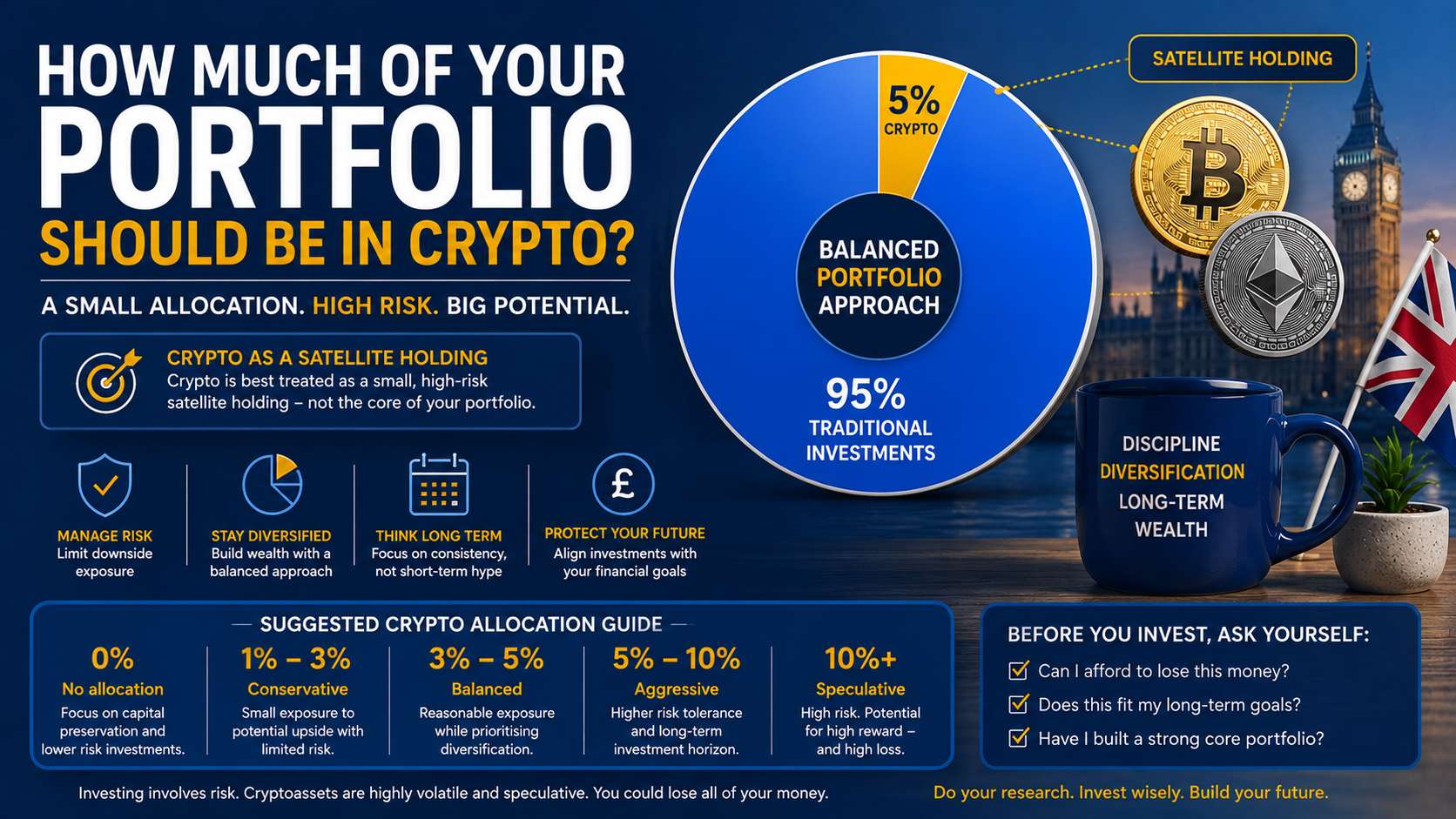
Many financial professionals who support Bitcoin exposure advocate for relatively small allocations. Common recommendations range from 1% to 5% of an overall portfolio. The reasoning is straightforward. A small position can potentially contribute meaningful gains if Bitcoin performs well, while limiting the damage if the investment performs poorly.
This approach treats Bitcoin as a satellite holding rather than a core portfolio asset. Core holdings typically remain diversified stock market funds, bonds and other established investments.
A modest allocation may also reduce the emotional impact of Bitcoin's volatility. Investors are less likely to make impulsive decisions if the position represents only a small percentage of their overall wealth.
Bitcoin Versus Traditional Investments.
Comparisons between Bitcoin and traditional investments are often oversimplified.
Shares represent ownership in businesses that generate profits and cash flow. Bonds provide income and contractual repayments. Property can generate rental income and potential capital growth.
Bitcoin offers none of these traditional characteristics. Instead, its investment thesis is based on scarcity, network adoption and demand growth.
This distinction means Bitcoin should not necessarily replace traditional investments. Many investors view it as a complement to an existing portfolio rather than an alternative to equities or bonds.
The FCA has repeatedly highlighted concerns that some younger investors are entering crypto markets before building exposure to more traditional investments. Critics argue that long-term wealth building is generally better served by establishing a diversified foundation before adding higher-risk assets.
What UK Investors Should Consider Before Buying Bitcoin.
Anyone considering Bitcoin should evaluate their financial situation carefully.
First, investors should ensure they have an emergency fund and manageable debt levels before investing in higher-risk assets. Bitcoin's volatility means money needed in the short term should not be invested in cryptocurrency.
Second, investors should understand the tax implications. In the UK, gains on cryptocurrency investments may be subject to Capital Gains Tax depending on individual circumstances.
Third, investors should consider their investment timeline. Bitcoin may be more suitable for investors with longer time horizons who can tolerate substantial short-term fluctuations.
Finally, investors should ask themselves a simple question: would they still be comfortable holding Bitcoin if its value fell by 50% or more? If the answer is no, any allocation may need to be smaller than initially planned.
The Bigger Picture For Long-Term Investors.
The Bitcoin debate often becomes polarised, with advocates predicting transformational gains and critics forecasting eventual collapse. The reality may lie somewhere between these extremes.
Bitcoin has demonstrated remarkable resilience since its creation, surviving regulatory challenges, market crashes and repeated predictions of failure. At the same time, it remains a speculative asset with risks that should not be ignored.
For some investors, a carefully sized Bitcoin allocation may enhance diversification and provide exposure to a developing asset class. For others, the volatility and uncertainty may outweigh the potential rewards.
Ultimately, the decision should depend on an investor's objectives, risk tolerance and broader financial plan rather than headlines, social media trends or fear of missing out. A balanced portfolio should be built around personal goals, not market hype.
Whether Bitcoin eventually becomes a permanent fixture in mainstream portfolios or remains a niche alternative asset, understanding both the opportunities and the risks is essential before committing any capital.
Want to build your investing knowledge? Subscribe today and claim your free copy of the Investing for Beginners Handbook to help start your investment journey with confidence.
Keep reading: What Are Alternative Assets? A Beginner's Guide for UK Investors, How Is Cryptocurrency Taxed in the UK? Capital Gains, Income and Reporting and Stocks and Shares ISA Explained in Plain English (2026/27): A Beginner's Guide to Tax-Free Investing.