Cryptocurrency has gone from a niche investment discussed on internet forums to a mainstream asset class that millions of people now own. Bitcoin, Ethereum and other digital assets have generated enormous returns over the past decade, but they have also experienced some of the sharpest declines investors have ever seen.
This creates an important question for investors. How much of your portfolio should be allocated to crypto, if any at all?
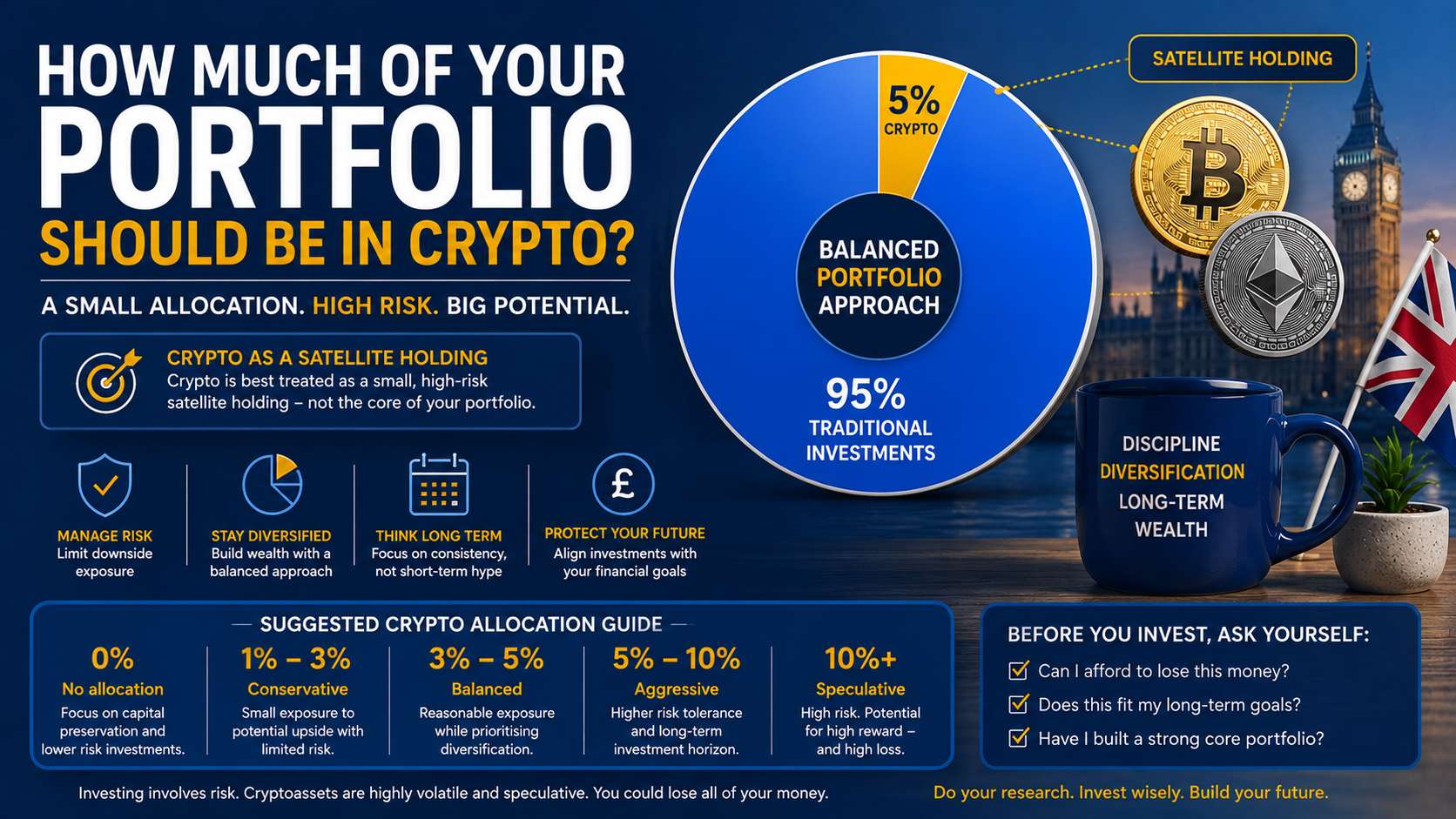
There is no universal answer because every investor has a different risk tolerance, investment timeline and financial situation. However, for most long-term investors, crypto is generally best viewed as a small, high-risk satellite holding rather than a core component of a portfolio.
Understanding where crypto fits within a broader investment strategy can help investors benefit from potential upside while limiting the damage that volatility can cause.
Why Crypto Is Different From Traditional Investments.
Traditional investments such as shares, bonds and property have decades, and in some cases centuries, of historical data behind them. Investors can analyse earnings, dividends, cash flows, economic trends and valuations to estimate future returns.
Cryptocurrencies are different.
While Bitcoin has become increasingly accepted as a digital asset, crypto remains highly speculative. Prices can rise dramatically during periods of optimism and fall equally quickly when sentiment changes.
The Financial Conduct Authority's latest research found that around 12% of UK adults owned cryptoassets in 2024, equivalent to approximately seven million people. Awareness of crypto has also risen to 93% of UK adults. Despite this growth, the FCA continues to warn that crypto remains a high-risk investment and investors should be prepared to lose all of their money.
This warning alone highlights why crypto should be treated differently from core long-term investments.
The Core And Satellite Approach.
Many professional investors use what is known as a core and satellite portfolio strategy.
The core portion of the portfolio contains diversified long-term investments designed to generate steady wealth over time. This may include global index funds, dividend-paying shares, bonds and other established assets.
Satellite holdings are smaller positions that carry greater risk but offer potentially higher returns. These investments are intended to complement the core portfolio rather than replace it.
Crypto fits naturally into the satellite category.
Instead of building a portfolio around cryptocurrency, investors can view it as a speculative position that sits alongside more traditional investments.
This approach helps prevent emotional decision-making and reduces the risk of a single investment derailing long-term financial goals.
What Percentage Should Be Allocated To Crypto?
While there is no perfect allocation, many financial professionals suggest limiting cryptocurrency exposure to a small percentage of total investable assets.
A cautious framework might look like this:
0% Allocation
Suitable for investors who do not understand crypto, dislike volatility or are focused entirely on capital preservation.
1% To 3% Allocation
Suitable for conservative investors who want exposure to potential upside without materially affecting their overall portfolio.
3% To 5% Allocation
Often considered a balanced allocation for investors who believe in the long-term future of digital assets but still prioritise diversified investing.
5% To 10% Allocation
Suitable only for investors with high risk tolerance and a long investment horizon. At this level, portfolio volatility can become more noticeable.
Above 10% Allocation
Generally considered speculative territory. While some investors have achieved significant gains from concentrated crypto positions, losses can be equally severe.
For many UK investors, an allocation between 1% and 5% may represent a sensible middle ground.
The Risk Of Overexposure.
One of the biggest mistakes investors make is allowing successful crypto investments to grow into oversized positions.
Imagine an investor allocates 5% of their portfolio to Bitcoin. After a strong bull market, that position grows to 20% or even 30% of total assets.
At this stage, the investor is taking significantly more risk than originally intended.
Rebalancing can help manage this issue. By periodically trimming gains and reallocating funds into other investments, investors maintain their desired risk level while locking in profits.
This discipline is often easier said than done, especially during periods when crypto prices appear unstoppable.
Understanding Volatility Before Investing.
Volatility is one of the defining characteristics of cryptocurrency.
Bitcoin has experienced multiple declines exceeding 50% throughout its history. Smaller cryptocurrencies have often fallen much further.
By comparison, the FTSE 100 and global stock markets generally experience less severe fluctuations over long periods.
Investors considering crypto should ask themselves a simple question.
Would I still sleep comfortably if this investment lost half of its value within a few months?
If the answer is no, the allocation is probably too large.
Position sizing should always be determined by an investor's ability to tolerate losses, not by potential gains.
Should Younger Investors Own More Crypto?
Younger investors often have longer investment horizons, which allows them to take more risk.
Someone in their twenties may be able to recover from market declines more easily than someone approaching retirement.
However, a longer time horizon does not automatically justify excessive crypto exposure.
Even younger investors benefit from diversification. A portfolio dominated by global equities, index funds and other productive assets is still likely to form the foundation of long-term wealth building.
Crypto can play a role, but it should rarely become the primary investment strategy.
What Crypto Investors Need To Know In The UK.
UK investors should be aware that cryptocurrency is treated differently from tax-efficient investments such as ISAs and pensions.
Profits made from cryptocurrency may be subject to Capital Gains Tax, depending on individual circumstances and annual allowances.
Investors should also understand that crypto assets generally do not benefit from Financial Services Compensation Scheme protection in the same way as regulated savings and investment products.
The FCA's research found that some investors incorrectly assume crypto investments receive protections that may not exist. This misunderstanding can create additional risks for inexperienced investors.
Before investing, it is worth understanding the tax implications and regulatory protections that apply to digital assets.
Crypto Should Complement A Portfolio, Not Define It.
The most successful long-term investors tend to focus on consistency rather than excitement.
Building wealth typically comes from regular investing, broad diversification, keeping costs low and maintaining discipline during market volatility.
Crypto can potentially enhance returns, but it should complement an existing investment plan rather than replace one.
For most investors, a diversified portfolio built around global shares, index funds and tax-efficient accounts such as ISAs and pensions is likely to remain the primary driver of long-term financial success.
A modest crypto allocation may provide exposure to future innovation while ensuring that short-term market swings do not jeopardise long-term goals.
The key is remembering that crypto should be a tool within a portfolio, not the portfolio itself.
Want to build your investing knowledge from the ground up? Subscribe today and get your free copy of the Investing for Beginners Handbook eBook.