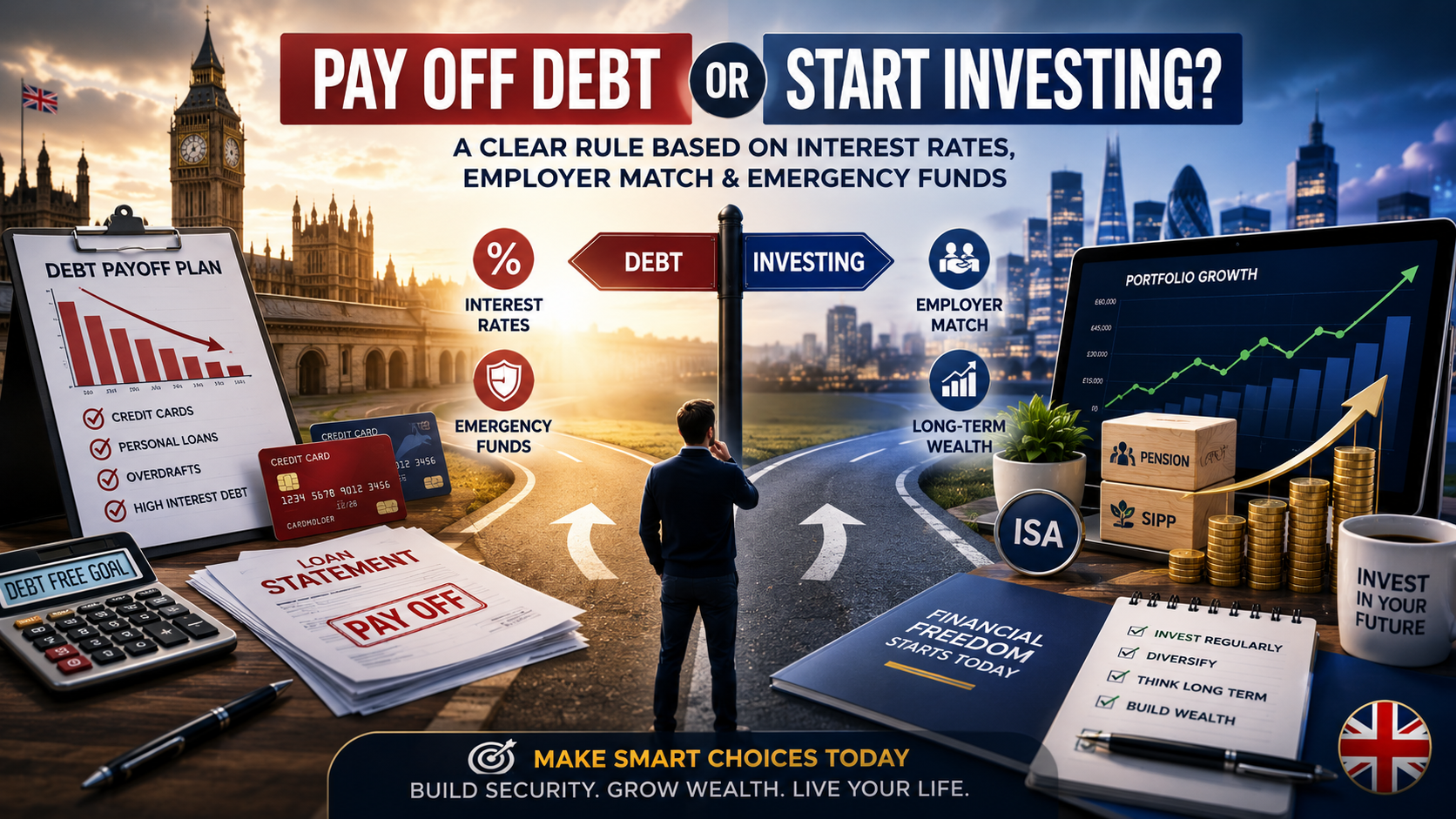
One of the most common personal finance questions in the UK is whether you should focus on paying off debt or start investing for the future. It is a decision that affects everything from monthly cash flow to retirement planning, yet many people approach it emotionally rather than logically.
The reality is that there is no single answer that works for everyone. The right choice depends on the type of debt you have, the interest rate attached to it, whether your employer offers pension matching, and whether you have enough savings to handle an emergency.
If you are trying to decide where your next pound should go, this guide provides a simple framework that can help you make a confident decision.
Start With An Emergency Fund.
Before focusing heavily on either debt repayment or investing, it is worth building a basic emergency fund.
Many people underestimate how quickly an unexpected expense can derail a financial plan. A broken boiler, urgent car repairs or a period of unemployment can force people back into expensive borrowing if they have no savings available.
Research suggests that financial resilience remains a challenge for many households. According to findings highlighted by The Guardian, around 16% of UK adults report having no savings at all, while 39% have £1,000 or less set aside.
For most people, a starter emergency fund of £1,000 to £2,000 is a sensible first target. Once high-interest debt is under control, this can be expanded to cover three to six months of essential expenses.
Having this financial buffer can often save more money than aggressive investing because it reduces the likelihood of relying on costly credit when life inevitably throws up surprises.
Never Ignore Free Money From Your Employer.
If your workplace pension offers employer matching, this should usually be your first investing priority.
Many employers will match employee pension contributions up to a certain percentage of salary. If you choose not to contribute enough to receive the full match, you are effectively turning down part of your compensation package.
For example, if you contribute £100 per month and your employer adds another £100, you have immediately achieved a 100% return before investment growth is even considered.
Very few investments can guarantee that level of return.
Workplace pension participation in the UK has increased significantly since automatic enrolment was introduced, with millions of workers now benefiting from employer contributions that can substantially accelerate retirement savings. This makes pension matching one of the most valuable wealth-building opportunities available to employees.
Even if you are carrying some debt, it often makes sense to contribute enough to capture the full employer match before directing additional money elsewhere.
The Interest Rate Rule.
Once you have a basic emergency fund and are receiving any available employer pension match, the next step is to compare your debt interest rate with the likely return from investing.
This is where many financial decisions become clearer.
As a general rule:
- Debt above 8% to 10% interest should usually be prioritised over investing.
- Debt below 4% to 5% interest may allow greater flexibility.
- Debt in the middle requires a balanced approach.
The reason is simple. Paying off debt provides a guaranteed return equal to the interest rate being charged.
If a credit card charges 25% interest, eliminating that debt delivers a risk-free 25% return on your money. Few investments can consistently achieve that level of performance.
According to UK debt statistics, average credit card interest rates have climbed to record highs in recent years, with some data showing average rates approaching 35% APR.
At those levels, paying off credit card balances should almost always take priority over investing.
High-Interest Debt Should Usually Come First.
Credit cards, overdrafts, payday loans and some personal loans often carry interest rates far above what most investors can reasonably expect to earn.
The UK currently has substantial levels of consumer debt. Outstanding credit card debt exceeded £73 billion in 2025, with average credit card debt standing at approximately £2,579 per household.
Many people invest while simultaneously carrying expensive debt, believing they are building wealth. In reality, they may simply be transferring money from one pocket to another while paying significant interest costs.
Imagine investing £5,000 and earning 7% annually while carrying a credit card balance charging 25%.
The investment might generate £350 over the year.
The debt could cost £1,250 in interest.
In that scenario, paying off the debt first would almost certainly be the superior financial move.
When Investing Can Make Sense Alongside Debt.
Not all debt should be treated equally.
A mortgage fixed at 3% is very different from a credit card charging 25%.
Low-interest borrowing can sometimes coexist with investing, especially when long-term investment returns are expected to exceed borrowing costs.
Historically, diversified stock market investments have delivered average annual returns above inflation over long periods. While future returns are never guaranteed, many investors use this principle to justify investing while maintaining lower-cost debt.
For example, someone with:
- A 2.5% mortgage
- A fully funded emergency fund
- No credit card debt
- Full employer pension matching
May reasonably decide to invest additional cash rather than make aggressive mortgage overpayments.
The key difference is that low-interest debt is unlikely to significantly undermine long-term investment growth.
A Practical Decision Framework.
For most people, the following order makes financial sense:
- Build a starter emergency fund.
- Contribute enough to receive the full employer pension match.
- Pay off high-interest debt.
- Expand emergency savings.
- Increase pension and investment contributions.
- Decide whether to accelerate repayment of lower-interest debt.
This approach balances financial security, wealth creation and risk management.
Rather than viewing debt repayment and investing as competing goals, it treats them as part of the same financial strategy.
Why Pensions Often Change The Equation.
One reason this debate becomes more complicated in the UK is the pension system.
Pension contributions benefit from tax relief, which effectively boosts every contribution you make.
Basic-rate taxpayers receive tax relief worth 20%, while higher-rate taxpayers may be entitled to even greater benefits.
Combined with employer matching, pension contributions can sometimes generate an immediate uplift that outweighs the interest cost of certain lower-rate debts.
For example, a worker contributing £80 into a pension may receive £20 in tax relief and additional employer contributions on top.
The result is that £80 of take-home pay can quickly become £120, £140 or more inside a pension.
This unique advantage is why pensions often remain a priority even when some debt still exists.
The Psychological Side Of The Decision.
Personal finance is not just about mathematics.
Some people value the peace of mind that comes from becoming debt-free. Others are motivated by seeing investments grow and compound over time.
Both perspectives have merit.
Research consistently shows that financial stress can affect wellbeing, relationships and productivity. Eliminating debt may improve confidence and reduce anxiety even if the mathematical outcome is slightly less efficient.
The best financial plan is often the one you can stick with consistently over many years.
If splitting your surplus between debt repayment and investing helps you stay motivated, that can be a perfectly reasonable approach.
Building Long-Term Wealth.
The biggest mistake is often doing neither.
Delaying investing indefinitely can mean missing years of compounding growth. At the same time, ignoring expensive debt can create a financial drag that becomes increasingly difficult to overcome.
The goal is not choosing debt repayment or investing.
The goal is building a system that improves your net worth year after year.
For most UK households, that means maintaining emergency savings, taking advantage of pension incentives, eliminating costly debt and investing consistently for the future.
The sooner you begin following a structured plan, the sooner your money starts working towards financial independence rather than simply servicing interest payments.
Whether you are just starting out or refining your financial strategy, understanding the relationship between debt, investing and pensions can help you make smarter decisions and build wealth more efficiently over the long term.
Want a simple roadmap to get started? Subscribe today and receive your free copy of the Investing for Beginners Handbook delivered straight to your inbox.
Keep reading: How to Start Investing in the UK: A Beginner's Step-by-Step Guide, Stocks and Shares ISA Explained in Plain English (2026/27): A Beginner's Guide to Tax-Free Investing, How to Invest Your First £1,000: A Beginner's Step-by-Step UK Guide and How Much Money Do You Need to Start Investing in the UK?.